Thursday, 2 March 2017

TOFU > MOFU > BOFU: Mapping Buyer Persona to the Buying Cycle Content for your Content Marketing Strategy

How to boost the effectiveness of your content marketing with properly mapped buyer personas

If you want to maximise results from your content marketing strategy, it is essential to map your buyer personas to the buying cycle. This is executed by delivering the right content, to the right people, at the right time.

If your business is B2B, your content marketing strategy is crucial to your success because 64 percent of B2B customers will engage in upwards of five blogs prior to purchase. However, a mere five percent of marketers believe their content marketing strategy is moving in the right direction, according to Top Rank Marketing.

Blogs, videos, ebooks, case studies, and infographics are all invaluable content marketing assets. And you want these content marketing assets represented in each stage of the buying cycle.

To make the absolute most of your content marketing strategy, you need to develop your buyer’s journey. This allows you to encompass purchase points for your buyer personas, ending with familiarity on both sides of the fence, simply driving sales.

Let’s take a closer look at how mapping buyer personas to the buying cycle can maximize your content marketing strategy.

What is a Buying Cycle and How Can You Use it With Your Content Marketing Strategy?

A buying cycle is essentially the journey you want your potential buyers to take. You want to take them from being completely unaware of your company’s mission, products, and services, to seeing you as a company they can count on for solutions.

The buying cycle consists of three key elements with a top down funnel approach. These elements are the Top of the Funnel (TOFU), Middle of the Funnel (MOFU), and Bottom of the Funnel (BOFU). This is why a buying cycle is often referred to as a buying funnel.

A buying cycle is comprised of five customer stages, including awareness, interest, evaluation, commitment, and sale. These customer stages are important, because they are where you want to utilize the right assets of your content marketing strategy.

Smart Insights Expert members can also download a persona template for mapping TOFU, MOFU and BOFU content to each persona from our researching personas guide.

Research by Ogilvy, Google and TNS found valuable brand connection attributes you can employ when mapping your buying personas to the buying cycle.

  • 73 percent chose a brand that offered useful information.
  • 70 percent chose a brand that engaged customer passions and interests.
  • 64 percent chose a brand that demonstrated its principles during evaluation.
  • 63 percent chose a brand that shared news, updates, and special offers.

All of these considerations need to be present as you map your personas to your brand’s buying stages.

What Type of Content Should You Create?

Noble Crawford, tech entrepreneur and CEO of Video Social Creative suggests,

“Depending on which stage of the buying cycle prospects are in, salespeople are wise to have three specific content assets readily available.”

Crawford identified blogs, videos and case studies as powerful content marketing assets. Below are a few more content marketing assets ranked by effectiveness.

  • Social Media Content (93 percent)
  • Case Studies (82 percent)
  • Blogs (81 percent)
  • E-Newsletters (81 percent)
  • In-Person Events (81 percent)
  • Articles on Your Website (79 percent)
  • Videos (79 percent)
  • Illustrations / Photos (76 percent)
  • White Papers (71 percent)
  • Infographics (67 percent)

Content Marketing Strategy for the “Top of the Funnel” (TOFU) of Your Buying Cycle

The TOFU is where your buying cycle begins. And understanding the content marketing assets you need to employ at this step is vital.

Potential buyers who have stumbled upon your website and content are generally unaware they need you. It is also possible they have an issue, but they are far from thinking about a solution.top-of-funnel-strategy

At this step of the buying cycle, you are simply raising awareness. You want to have the right content to engage and connect with your potential customer.

However, you want to stay away from any sales focused pitches. Offer value first, allowing potential buyers to gain insight about their issue, and seek the solution you are about to propose.

content-marketing

Blogs, expert content, videos, and infographics are assets you want to use at this stage in your content marketing strategy buying cycle:

  • Blogs are certainly the most common content regarding TOFU. They should be informative and offer a connection between potential buyers and your solutions. Simply focus on giving massive value to your readers.
  • Expert Content. Expert content, or pillar content, is detailed and used as a powerful education tool to raise awareness and fix pain points for your buyers.
  • Using videos as part of your content marketing strategy is a powerful way to create awareness. Video in emails can lead to a 200 to 300 percent CTR increase, according to Small Business Trends. And 92 percent of mobile video viewers will share videos.
  • Infographics are almost as powerful as videos when it comes to your buying cycle and content marketing strategy. Research on colorful visuals by Xerox found that people are 80 percent more engaged in reading content if it is presented using visuals. But don’t get to caught up on graphics. You want your infographics to include plenty of useful data too.

At the awareness stage, you want to focus on helping to identify the pain points of your buyer personas and offering them solutions to solve these pain points.

Content Marketing Strategy for the “Middle of the Funnel” (MOFU) of Your Buying Cycle

The MOFU of your buying cycle is a very important moment. It is when your potential buyers have become aware of an issue and are actively seeking a solution. It so happens that you have the solution, but your potential buyer has yet to realize it.

During this step of the buying cycle, potential buyers are gathering information about the solutions they now realize they need. And your goal is to ensure they understand what they need, and how your company’s products and services meet that necessity.

This is when you begin to nurture and educate. Utilizing assets in your content marketing strategy that educate your potential buyers is best practice. You want them to visualize your solution without the pushy sales routine.

Ebooks, white papers, and webinars are all exceptional content marketing aspects you can employ during this step in your buying cycle.

  • Offering in-depth content in ebooks not only creates value by informing your audience, it also allows you to build your email list and increase ROI efforts, according to Forbes.
  • White papers. Relatively similar to ebooks, white papers a should be focused, concise, and more in-depth. Think academic peer-reviewed articles with lots of data point and possibly sharing groundbreaking research that others in the industry haven’t shared.

content-strategy

At this stage, your buyers understand they have a problem and know that your company offers a solution. They are exploring potential ways of solving their problems and companies who offer the products or services they need. Showing them though leadership can help create brand affinity and create an opportunity for them to connect with you and choose to buy from your brand, over others.

Content Marketing Strategy for the “Bottom of the Funnel” (BOFU) of Your Buying Cycle

Once potential buyers have reached this step in your buying cycle, it’s time to get more sales minded. You have now successfully mapped your buyer personas to the content marketing assets that drive commitment and sales.

The BOFU is where your potential buyers have read, watched, and researched your solution. They are not ready to choose you just yet, but you are in the running. Potential buyers commonly compare you to your competitors at this step in the buying cycle.

Employing demo videos, comparisons, case studies, and influencer resources are all powerful assets to employ during this very important moment. Free trials and product specs can also be useful asset at this stage as well.

  • Expert Content. Interview experts and industry influencers and get them to endorse your company. Using influencers is nvaluable during a potential buyer’s evaluation process. A report by Google found that 74 percent of people made purchases based on a key influencer’s recommendation.
  • Demo videos. Demo videos make potential buyers into buyers and followers. They are essentially tours of how your solution is the best fit. Demo videos can be live or recorded and uploaded. You can use this content marketing asset to showcase your products and services in real time, making the bottom of your buying cycle sales driven.
  • Product Comparisons. Comparisons are another useful BOFU asset to drive sales at the bottom of your buying cycle. Many potential buyers are on the fence, comparing your solutions to your competitors. A comparison based on how you stack up against competitors is best practice in saturated industries.

Maximize Your Content Marketing Strategy with Powerful Buying Cycle Assets

Mapping your buyer personas to the buying cycle of your content marketing strategy is vital to boosting your brand awareness and converting potential buyers into purchasers.

The benefits of a well-developed content marketing strategy is a two-way street as well. Your customers get the solutions they need, and you get to maximise your marketing efforts.

Mapping your content strategy to your customer’s buying cycle lets you use the right content assets, for the right people, at the most opportune moments. This most certainly increases those coveted conversions, allowing your business to grow exponentially and your investment in content to be maximised.



from Blog – Smart Insights http://www.smartinsights.com/content-management/content-marketing-strategy/mapping-buyer-personas-buying-cycle-content-marketing-strategy/

via Tumblr http://euro3plast-fr.tumblr.com/post/157897548589

Wednesday, 1 March 2017

Challenges Faced by Email Marketers – Subscriber List Growth

Chart of the Day: What challenges you when it comes to email marketing? Part 2 of 4.

For email marketers, there will always be aspects of email marketing that are a challenge. The below chart looks at the various areas that email marketers are struggling with. I will be doing a 4 part series of issues pertaining to email marketing.

We will be looking at the following during the course of the series:

The second challenge in the series is “Subscriber list growth”. Organically grown subscriber lists are challenging and it takes time to expand them. But having a large list isn’t everything, you need to make sure it’s an engaging list. Meaning clients trust your brand, open your email and ultimately click on the content that is relevant to them.

How do I grow a subscriber list?

In the chart below, we have various ways to grow your list. Opt-in forms and social media are on par, with 61% and 60% respectively. So you need to make sure you make it easy for a client to opt-in, but also to make very clear that they are being opted-in to an email subscription service, e.g: creating a account will automatically add them to your list.

What is worrying, is there are still 28% who rent/buy lists. Buying lists is bad email marketing practice. And it is/will be illegal in some countries. It may be quicker, but not better.

After you have the customer opted-in, you need to keep them interacted with you. So sending information that is relevant and of interest to them to keep them engaged.

Subscriber list growth is discussed in greater detail in our blog post, Growing email subscribers.

Email marketing challenges


from Blog – Smart Insights http://www.smartinsights.com/email-marketing/email-list-management-ecrm/challenges-faced-by-email-marketers-subscriber-list-growth/

via Tumblr http://euro3plast-fr.tumblr.com/post/157865570089

7 Marketing Trends for Niche Businesses in 2017

Utilize these important trends this year if you have a niche product 

Niche businesses usually cater to a relatively small and well-defined market by tapping an unmet demand. For example, Lefty’s store is a good example of niche business as it sells products for left handed people. Other examples of niche businesses include GetOutfitted, YearBook Innovation, and boutique consulting firms which provide consulting services to specific industries. Google, Facebook, Twitter, and LinkedIn are all examples of niche technology businesses which went on to become mass business later.

Niche businesses need to do focused marketing to become profitable as they serve a small segment of the market. Traditionally, niche marketers have used demand based marketing methods such as Pay-per-click advertising and focused industry events for promoting their products or services. However, advancement in marketing technology has led to many options that niche marketers can adopt to grow their business.

Below are seven marketing trends that niche companies can choose in 2017 for attaining success and sustaining in a highly competitive economy.

CEO Branding

CEO branding is not new. However, it has regained its importance recently. The online space is getting cluttered, and few people trust brands on social media. Thus, the companies need to be authentic and invest in winning the confidence of its target audience to succeed in online marketing. Branding of CEOs plays a crucial role in ensuring the creation of the right perception of the brand.

Niche businesses that have a well-recognized CEO see an increased flow of deals and get bigger dollars. Moreover, companies can use a variety of marketing methods to gain access to their target audience. News media also takes a keen interest in inspirational stories built around successful individuals. Therefore, branding of CEOs can attract broad press coverage which is otherwise difficult through paid advertising. Also, third party validation improves the credibility of brands in the minds of the consumers.  

Apple, Microsoft, Virgin and Walt Disney got distinct marketing advantage in their early stages due to the excellent branding of their respective CEOs, Steve Jobs, Richard Branson, Walt Disney and Microsoft.

Convergence of Online and Offline Marketing

Niche business owners and marketers rely greatly on offline industry events to connect with their audience and generate leads. Although time-consuming, this method has helped marketers in expanding their professional network extensively.

In 2017, integration of online and offline marketing techniques is essential to broaden the reach and increase influence. Many niche businesses find it hard to get desired traffic on their blogs despite great content and excellent advice. It seems that brilliant content is not enough to generate page views.

It is the need of the time to integrate online and offline marketing techniques. You can use the strong network built by offline marketing techniques to increase your page views. The increased traffic can be helpful in generating more sales through a right content marketing approach. The chart below shows consumer touch points across the customer lifecycle, both on and offline. 

Video Case Studies

For long, niche businesses have used case studies as a useful content marketing tool for promoting their products. A massive influx of content and other distractions have led to short attention span for most of the internet users. Thus, very few people read lengthy content or business case studies until it comes from a reputed brand.

On the other hand, 2016 saw a rise in video views across all platforms such as Facebook, Snapchat, and Youtube. Even popular TV shows have been launched on social networks in bite-sized videos. Niche businesses have a tremendous opportunity in video marketing. They can develop interesting case studies in a video format and promote them on various social networking sites. The videos also help in overall search engine optimization of the sites. Develop a combination of text and video-based case studies and run an A/B testing program to gauge the effectiveness of each format. You will have a fair understanding of how users’ behavior have been changing over time. You can modify your future marketing strategies accordingly.

Check this 16 video case studies that connect directly with the intended audience.

Affiliate Marketing

Traditionally, affiliate marketing has been used by e-commerce firms or other companies which sell digital products such as e-books, online courses, etc.  However, this trend is slated to change and involve niche businesses in their fold in 2017. The industry has witnessed a significant rise in the number quality publishers that target a particular segment of the market.  The publishers have built a valuable audience base through quality content and marketing capabilities.  These publishers can monetize their platform with the help of advertisers who are looking for similar audience base. Thus, niche businesses can utilize performance based marketing to generate relevant leads for their business.

GogoTraining increased its sales by almost 120% in a year by using Shareasale affiliate marketing platform.

Marketing Automation

Scalability is a major challenge for most of the niche businesses. They need to define a precise target audience and find them efficiently. They also need to put in more money in placing ads and human resources to manage various marketing activities.

Niche businesses can use marketing automation tool to address this challenge. With the help of big data and predictive analytics, they can define target audience with high precision and can set several of their marketing activities on autopilot mode. Since marketing automation works only in digital realms, the marketers need fewer human resources to scale their marketing operations and increase their reach. Marketing automation will also be useful in integrating online and offline marketing activities.

Here are the examples of some companies which used marketing automation to increase their sales.

Primary research-based Insights and Content

With a flood of content on the internet, the niche businesses need to invest in capabilities to develop insights and content based on primary research. It includes information and ideas which are not yet identified by the competitors. Such contents are more likely to be shared by the influencers as they contain authentic and first-hand information. Thus the niche businesses can become suppliers of original information to the influencers in the industry and get free publicity due to their authenticity in return.

Here is how an adult website used the power of research-based insights to legitimately promote adult content in a country where such promotions are banned.

Focus on Creative Communication

Certain things never change. Creative communication is one such asset that has always delivered dividends for businesses and will continue to do so in times to come.

Be creative, practical and put fun elements in your communication strategies. Connecting with emotional chords of consumers will help in differentiating the message and increasing brand recall.

Even small businesses with boring products or services have started putting humor in the communication style to stand out in a crowded media space. Thus, never be afraid of experimenting with your communication style and building stories that attract the attention of press and influencers.

Check this video to understand the power of words and how it can alter your business.

The above trends will witness an increase in popularity in 2017. Niche businesses can use them to their advantage by developing appropriate marketing strategies based on the nature and characteristics of their business.


from Blog – Smart Insights http://www.smartinsights.com/online-brand-strategy/brand-positioning/7-marketing-trends-niche-businesses-2017/

via Tumblr http://euro3plast-fr.tumblr.com/post/157863686864

Mobile Marketing Statistics compilation

Statistics on consumer mobile usage and adoption to inform your mobile marketing strategy mobile site design and app development

“Mobile to overtake fixed Internet access by 2014" was the huge headline summarising the bold prediction from 2008 by Mary Meeker, an analyst at Kleiner Perkins Caufield Byers who reviews technology trends annually in May.

The mobile statistics that the team at Smart Insights curate in the regular updates to this article include:

  • Ownership of smartphone vs Desktop
  • Mobile vs desktop media and website use
  • Mobile advertising response
  • Smartphone vs Tablet vs Desktop conversion rates

Well, we’re now past the mobile Tipping Point as this report from comScore shows. So it’s no longer a case of asking whether mobile marketing important, we know it is! It’s now a question of using the statistics to understand how consumers behave when using different types of mobile devices and what their preferences are.

Mobile stats vs desktop-users-global

To help you keep up-to-date with the rise in consumer and company adoption of mobile and its impact on mobile marketing, I will keep this post updated throughout 2016 as the new stats come through to support our 120 page Expert members Ebook explaining how to create a  mobile marketing strategy. We also have this free summary mobile strategy briefing for Basic members.

We have  grouped the latest mobile stats under these headings for key questions marketers need to answer about mobile to help them compete:

  • Q1. Time spent using mobile media
  • Q2. Percentage of consumers using mobile devices
  • Q3.  How many website visits are on mobile vs desktop devices?
  • Q4. Mobile device conversion rates and visit share for Ecommerce sites?
  • Q5. Mobile - app vs mobile site usage?
  • Q6. How important are mobile ads

OK, let’s go!

Q1. How much time do consumers spend using mobile media?

Mobile media use varies through the day. This is important to understand for dayparting, i.e. buying AdWords and display media.This research from comScore Global Digital Future in Focus shows how desktop is still important for daytime at work audiences, but Tablet and smartphone dominate in the evening.

The latest figures, also from comScore Mobile Metrix presented in the OfCom Communications Market report show the total browse time per month is much higher on smartphones - these figures compare to 34 hours and 29 hourse for the United States and United Kingdom on desktop.

Mary Meeker’s annual spring updates on mobile are a must-read if you follow consumer adoption of technology platforms, so we have used some of the key findings from the latest KPCB mobile technology trends by Mary Meeker. Her deck is nearly 200 slides, so we have selected the statistics which best summarise the importance of mobile devices today.

The latest data shows that we are now well past the tipping point mentioned at the top of this post. Mobile digital media time in the US is now significantly higher at 51% compared to desktop (42%).

mobile

The implications are clear - if you’re not able to reach your audience through mobile search or display, or you’re not providing a satisfactory mobile experience you will miss out compared to competitors who are.

Q2. Percentage of consumers using mobile devices?

This Ofcom international benchmark shows the global popularity of using different digital devices in representative countries.

This interesting visual from comScore also part of their digital future in focus shows the picture that marketers need to build up. This panel data shows that the majority of consumers are multiplatform and will often be multi-screening, accessing sites on mobile or desktop, so consistent experiences across device need to be deployed.

You need to answer this for your own site. As Rob Thurner explained in his post on KPIs to review m-commerce effectiveness, it’s important to keep track of the split between users of mobile and desktop devices visiting your site(s). Using  segments in Google Analytics is the best way to do this.

Q3. How many website visits are on mobile vs desktop devices?

However, we need to be careful with interpreting data on hours spent, since we spend most of our time on smartphones checking email and using social media. This has led to the common mantra of ‘Mobile-First’ design which I think is dangerous, or at least oversimplistic! Eric Schmidt, then Chairman of Google talked about a Mobile-First approach. The reality is that while smartphone use is overwhelmingly popular for some activities such as social media, messaging and catching up with news and gossip, the majority of consumers in western markets also have desktop (and tablet) devices which they tend to use for more detailed review and purchasing. So we need to think about strategies to engage what comScore call the Multichannel Majority not simply 'mobile first’ or 'smartphone adoption’.  This explains why mobile conversion rates are much lower in retail and why the breakdown between traffic for retail sites is broadly equal between smartphone and desktop. Audience measurement platform comScore has talked for some time about strategies to engage and measure the multiplatform majority across devices and I think there will, or should be more focus on that in the years ahead.

This UK data also shows the importance of the multichannel majority in sectors like Retail and to a lesser extent banking, but that for some niches like weather 'mobile first’ is more accurate.

Their latest data for the US is striking in shows how the multi-device majority dominate, particularly amongst millenials.

Although mobile is growing in importance, this older data from Adobe’s latest Digital Index (not updated yet) shows that in all industries the majority of visits are still on desktop.

Percentage of desktop vs mobile visits 2016 data

So with so many site visits still on desktop, it’s important when designing using a responsive web design that the desktop experience isn’t degraded and this has led to many larger businesses using an adaptive web design where layout and content are tailored for desktop, tablet and smartphone screen dimensions.

Q4. Mobile device conversion rates and visit share for Ecommerce sites?

We have a separate compilation of Ecommerce conversion stats if you’re creating a business case for mobile optimised sites as explained in our mobile marketing strategy guide, this data is also valuable since it shows the variation in conversion rate by mobile type. This is the latest data from Monetate for their retail clients showing conversion rates.

Their latest quarterly update from November 2016 shows conversion rates to add-to-basket or cart and below sale across the last 4 quarters, up to the Q3 2016:

The data clearly shows that Smartphone conversion rates are much lower than for desktop - important if you’re making the business case for a mobile responsive site.

This source is useful since it’s a regular survey showing the growth in use of mobile site visitors. enables you to drill down to see usage by device type, for example iPad is still the dominant tablet, but Kindle Fire and Android tablets now account for over 10% of tablets. You can see that tablet and smartphone use nearly doubled in the year based on 500 million plus visits for these retail clients (see link above for methodology).

Q5. Mobile media time - app vs mobile site usage? App usage (90% of time) dominates browsers in mobile usage

Consumer preference for mobile apps vs mobile sites should also be thought through as part of mobile strategy.

Today, the latest data from Yahoo’s Flurry analytics shows that 90 percent of consumer’s mobile time is spent in apps. As they put it: It’s an App World. The Web Just Lives in It. This is a key insight as companies decide whether to develop mobile apps or create mobile device specific apps.

This 90% figure is a key insight as companies decide whether to develop mobile apps or restrict themselves to mobile optimised sites.  You do have to be careful about interpreting this since, as the chart below shows, Facebook, messaging, games and utility apps will naturally have the greatest time spent and browser use is still significant by volume if not proportion. But this has implications for advertising on mobile to reach consumers using apps like Facebook and Gmail.

Q6. Mobile Ad Spend still lags behind Mobile Media Consumption

So, how have advertisers responded to the change in mobile media time? The next chart shows that despite the growth in media time above, some advertisers are missing out since the right-most bar shows that there is a huge missing opportunity on mobile advertising

internet trends

This research sourced from a 2015 study by eMarketer into mobile ad budgets shows a different view. In 2015 mobile ad spending accounts for 49% of digital ad spending, which is only slightly behind the trends of how people are using their devices. These stats also show projections for future growth, which is important as it shows where the market is going. It is clear that mobile is the future, and within 3 years it will come to dominate digital ad spending.

  2015 2016 2017 2018 2019
Mobile Ad spending- Billions $ 28.7 40.5 49.8 57.7 65.8
Percentage change 50% 41% 23% 16% 14%
Percentage of digital ad spending 49% 60.4% 66.6% 69.7% 72.2%

Q7. How consumers research products using mobile search and review sites

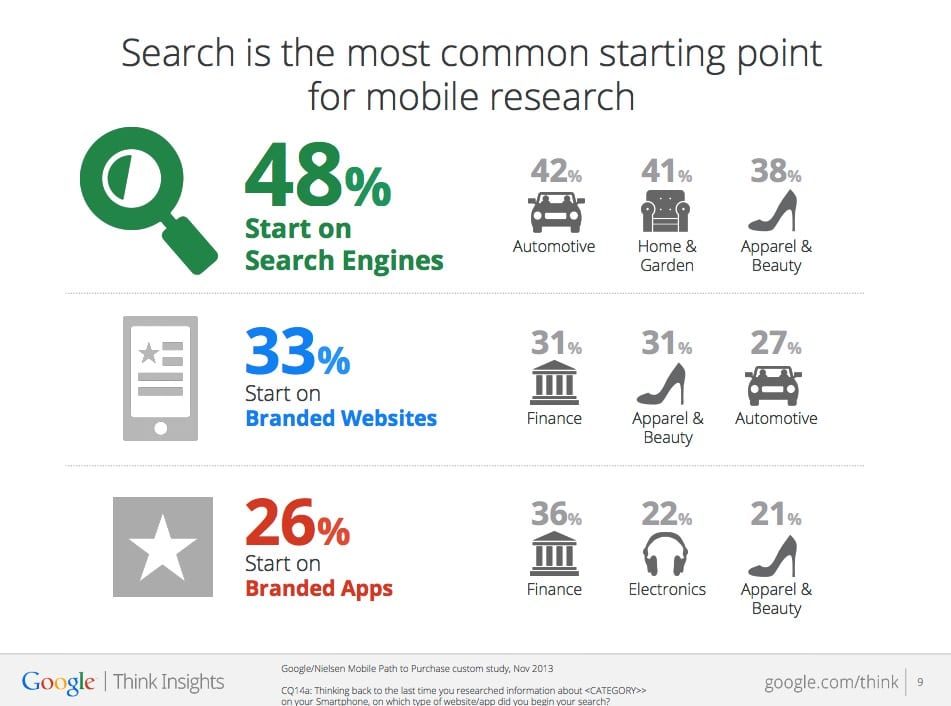
Google’s mobile path to purchase report surveyed 950 US consumers across 9 different verticals (Restaurants, Food & Cooking, Finance, Travel, Home & Garden, Apparel & Beauty, Automotive, Electronics, Health & Nutrition) to assess how they researched purchases via mobile. A key finding is the starting point for mobile research. As might be expected search was the most common starting point, but it’s lower than desktop showing the importance of branded apps and mobile sites.

Mobile commerce statistics 2014 research

The 5 best sources for reviewing mobile marketing statistics in 2017?

This update to this post features some of the latest updates on mobile statistics from 2014 and highlight some of the best sources to make the business case for investment in mobile marketing in your presentations and business cases to colleagues or clients.

  • 1. Google Consumer Barometer. A regular survey for different countries starting in 2011, this enabled you to prepare your own reports. Google’s Consumer barometer  enables you to create similar reports.
  • 2. ITU. The International Telecoms Union data reports mobile usage including mobile broadband subscriptions to show growth in use of mobile. This reported at country, continent and overall levels, so is the best overall source for mobile penetration worldwide. Much of the information is free - see their free mobile statistics section.
  • 3. Flurry Mobile Analytics. This is a great source for showing the overall level of app usage across the four major mobile app platforms by country and drilling down into the popularity of individual apps for different sectors like retail, banking and travel. For example, the latest mobile app growth figures from Flurry show growth of category use by more than 50% in many categories.
  • 4. Comscore Digital Future Series. Comscore is one of the key worldwide sources useful for marketers to help us find out about the changes in use of mobile media by consumers. You will see we have referenced this a lot. This graph shows the pattern across Europe - follow the link above for US and other country breakdowns.
  • 5. Ofcom Internet usage report. Ofcom’s Tenth International Communications Market Report was published in December 2016, this examines take-up, availability, price and use of broadband, landlines, mobiles, TV, radio and post across 17 major countries.

We hope this compilation of statistics about mobile usage and effectiveness continues to be useful - please share if it is and we’ll continue to update it in 2017.

If you want a single source of the latest stats across the whole of digital marketing, for Expert members, we compile a regularly updated set of usage statistics to use in presentations - it’s updated each quarter so all the latest stats are categorised in a single place for including in presentations. Our Expert member resources also include templates and guides to help create digital strategy and plans.


from Blog – Smart Insights http://www.smartinsights.com/mobile-marketing/mobile-marketing-analytics/mobile-marketing-statistics/

via Tumblr http://euro3plast-fr.tumblr.com/post/157859275934

How to create a personal brand in 2017

The secrets to personal branding success

Good branding can make or break your success: it stands for companies, and it stands for personal brands as well. Nowadays, personal branding is more important than ever, particularly if you are an entrepreneur or solopreneur, or if you work in a company. In this blog post, I want to show you the best way to start building up your personal brand in 2017.

Why personal branding?

Personal branding has become almost a necessity in recent years, especially for people in certain niches. The reason for that is other people that you come into contact with, particularly clients and employers will likely also check your online persona.

By building up your personal brand, you’ll be able to put your best foot forward online – which will also influence your success in the real world as well.

As an entrepreneur, there are even more benefits to creating a personal brand. People generally prefer the person behind the business to the actual business, as it’s something they can connect with. By building up your personal brand, you will be able to grow your business faster and find potential investors and clients more easily.

Now, let’s get into what you need to do in order to start your very own personal brand:

Be visible and be active

The first step towards building up your personal brand is that you need to be as visible as possible online:

  • Create a blog or a website where people can learn more about you
  • Join social profiles and be active
  • Join online communities and social groups where you interact with others

You don’t necessarily need to be on every major social network and start a blog. Rather, keep to what you know realistically you have the time to manage properly and stick with it.

Since you will need to be very active in order to be successful, and engage as much as possible with other people, it’s better to not stretch yourself too thin.

That said, if you’re not seen by people, you won’t be able to truly brand yourself. Find the perfect balance for yourself, so as to make sure that you are visible, but not on so many platforms that you don’t have the time to manage any of them properly.

Grow your social influence

Social media offers even the most regular of people a chance at growing their influence online. And an improved influence, means a better, stronger personal brand.

In order to become an influencer, you will need to essentially become a thought leader in your niche, a person who others look up to for advice, tips or in other cases, for entertainment.

In order to grow your own social influence, you will need to be extra active online, and preferably, also have a blog which is updated regularly with new posts. Influencers can’t grow unless there is consistency.

As I mentioned earlier, as an influencer, you become a source of great information from whatever your niche is. This means that you need to share the top content, write insightful posts of your own, provide tips and advice to others and so on.

Another important factor is engagement: just like with personal branding, if you want to grow your influence, you will need to engage with other users as much as possible. Ask and answer questions, join groups and engage there regularly to get your name seen by others, network online and at events, take part in Twitter Chats and so on. The more you engage with others, the better for your influence, and for your personal brand.

Know who you are and what makes you unique

Just like with regular brands, a personal brand needs to have a clear direction.

In order to be able to build your brand, you need to know who you are: what makes you, you? What qualities make you unique? What makes you stand out? And how can you use these for your personal brand.

This is not a question of hiding things about yourself, or changing your personality to fit the idea of the perfect personal brand. Rather, it’s about using your best qualities and always bringing your best foot forward when you’re presenting yourself to others, online and offline.

Consistency is also very important to your success – just like with regular brands. Before you start building your brand, be clear on who you are and what image you want to portray to others, and then stick to it.

Branding: it’s in the little things

With branding, it’s sometimes the little things that can make the biggest difference to your success.

For example, you could consider creating a logo for yourself. This is especially useful if you have a website or a blog. A logo can help you look more professional, as well as make your brand stand out. You can use a tool like Tailor Brands to quickly create yourself a custom logo.

Another thing that can make a big difference is including a professional signature to all of your emails.

Most email providers will let you create a signature, or if you want a more professional-looking signature and one that includes links to your social profiles, you can use a tool like WiseStamp to create it.

Live streaming

Live streaming continues to be huge this year on social media. Use this popular (relatively) new medium to grow your personal brand and reach more people.

As Facebook is pushing this feature, it’s much more likely that a live stream will pop up in people’s news feeds, rather than a regular update. It’s unclear how long this will last – but while it still is, make sure to profit from the increased reach that live streaming gives you. And, now that Twitter has also included this feature, you have even more options for platforms.

There are lots of ways that you can use live streaming, for example to perform a product tutorial for a product that your audience would be interested in, to live stream from an event, or to take an interview of an interesting person that your audience would love to hear from.

Engage with social influencers

Another way of building up your profile online is to create connections with social influencers. As they start mentioning you or your work, it can really help you build your profile, not to mention, you will also be reaching their larger than average and very engaged audience.

Search for influencers in your niche and then simply start engaging to build these relationships. A platform like Clearvoice can help you map out and connect with influencers in many niches. Engage on their websites and blogs, as well as on social media and, where possible, take it to the offline as well: go to industry events, conferences and so on as this will not only help you meet influencers, but it will also improve your own visibility. The more people get to meet you, the better the chances of your personal brand growing and evolving.

Conclusion

A good personal brand can help you achieve more success in your career, or as an entrepreneur, it can help propel your business to success, much faster and easier. Are you thinking of building up your own personal brand? What are some of the best personal brands you’ve encountered online and why?


from Blog – Smart Insights http://www.smartinsights.com/managing-digital-marketing/personal-career-development/create-personal-brand-2017/

via Tumblr http://euro3plast-fr.tumblr.com/post/157858305224

New Thought-Leadership Sessions Added at Adobe Summit

The Marketing Innovations track is all about inspiration. We want you to be inspired with new ways to solve problems. We want you to be inspired with innovative ways to use technology. We want you to be inspired with big ideas that will drive the future.

And, all this inspiration will be waiting for you at Adobe Summit this March 21 – 23rd in Vegas.

Explore These Featured Sessions for the Marketing Innovations Track.
This year, Adobe Summit is focused on designing and delivering better experiences for your customers. However, you deserve to have a few great experiences for yourself too. Here are a few sessions you don’t want to miss.

Shareology: How Sharing Powers the Human Economy.
Sharing is a competitive advantage. This fundamental human behavior that allows us to connect with others and to advance as a species has been central to our survival. And today, it’s central to your business. Join best-selling author and global keynote speaker Bryan Kramer as he shares insights on the art and science of sharing, including its value to your personal and corporate brands. In this thoughtful presentation, Kramer suggests a new way to deliver value in this experience-based world and prompts us to rethink how, what, why, and where we share ideas to influence our global tribe. (Wednesday March 22nd 8:30am – 9:30am — Reserve your spot.)

Redefining the Way the World Learns.(new)
The rules of education are changing. Businesses and individuals can now improve their skills and knowledge base in a matter of hours rather than years at a university. Join Aaron Skonnard, the CEO of Pluralsight, to learn about the democratization of learning through innovative technology. You’ll learn how to build a career that you’re passionate about as well as how the new wave of learning technology is no longer confined to a classroom, an institutional schedule, or a select minority. (Tuesday March 21st 5:30pm – 6:30pm — Reserve your spot.)

How Prudential Built an Agency.
How can an in-house agency create a competitive edge for a company? Just look at Prudential. Prudential’s in-house agency was created more than 20 years ago, long before “insourcing” became a trend. Launched as an efficiency drive, the in-house team is now a full-service, integrated agency that can stand toe to toe with the best external agencies. In this fireside chat, Niharika Shah, VP and head of brand marketing and advertising at Prudential Financial, gives you an inside look at the evolution of the company’s in-house agency, the processes and types of people in place, and the resulting benefits. (Tuesday March 21st 4:00pm – 5:00pm — Reserve your spot.)

Out With the Old, in With the VR: USA Today on Immersive Storytelling
As VR (virtual reality) becomes more mainstream, USA TODAY NETWORK is exploring how to best use the medium as an immersive storytelling tool and a branded platform to bring new experiences to consumers of varied interests. Hear from CMO, Andy Yost; director of emerging technology, Niko Chauls; and SVP/head of GET Creative, Kelly Andresen as they discuss their key learnings from introducing a new medium to their audience and advertisers and how they’re moving forward on setting VR standards for the media industry. (Tuesday March 21st 2:30pm – 3:30pm — Reserve your spot.)

A Better Experience Starts With Adobe Experience Management.(new)
In this presentation with Ryan Green, CEO and founder of Qualtrics, you’ll learn how to gain better control over your customer experience programs. Ryan will share how to get deeper insights from customers and employees through relevant research and data; and then, he’ll explain how to use that feedback to build greater brand loyalty — and all in real time. (Tuesday March 21st 4:00pm – 5:00pm — Reserve your spot.)

We’ve Made Exciting Updates to the Marketing Innovations Track.
We’re also excited to announce more updates to the Marketing Innovations track at Adobe Summit. We’ve expanded the track to include three times the number of sessions we had last year, and we’ve elevated the type of content and insights to better help companies understand and thrive in the new digital landscape.

The new Marketing Innovations track will focus on two types of inspiration — innovation of thought and innovation of action. For innovation of thought, we’re hosting a variety of speakers, best-selling authors, and thought leaders who will inspire you with big ideas, trends, and guidance on digital transformation. For innovation of action, we’re inviting a variety of brands, CMOs, and entrepreneurs who will share insights and examples of how they’re using technology to push the limits of digital marketing with their companies.

Be Inspired!
In addition to many outside experts, we also have several experts from Adobe who will provide deep insights on topics such as future digital trends, the value of design in business ROI, and the role of technology in digitally transforming your company.

The idea is to take the inspiration you find on the mainstage and make it available through a variety of topics and at times that will fit your conference schedule. The sessions in the Marketing Innovations track are available to everyone at Adobe Summit — from CEOs to practitioners. Simply visit summit.adobe.com to view our session catalog and read more details about all the sessions in our Marketing Innovations track.

Your inspiration starts now.

The post New Thought-Leadership Sessions Added at Adobe Summit appeared first on Digital Marketing Blog by Adobe.


from Digital Marketing Blog by Adobe https://blogs.adobe.com/digitalmarketing/digital-marketing/new-thought-leadership-sessions-added-at-adobe-summit/

via Tumblr http://euro3plast-fr.tumblr.com/post/157856881684

A blueprint for evaluating content marketing ROI

Content marketing works, but measuring content marketing ROI is challenging

In the Smart Insights-Hubspot research into content marketing in Europe, 44.4% of marketing managers who responded to the survey, say they struggle to measure the return on their content marketing investment.

guide to evaluating content marketing roi

44.4% of marketing managers struggle to measure content ROI

This inability to measure the ROI of content marketing confirms a need for more guidance on how to calculate the cost of content marketing and measure the return on investment.

In this post I want to walk you through a simple but effective costing model, and show you how, by breaking out the component costs of content into labour, production and distribution, you can work out your content marketing cost, which provides the basis for evaluating your content marketing ROI.

Content marketing cost

Broadly speaking, content marketing can be divided into 5 cost centres:

the cost of content marketing

Content Marketing: 5 Cost Centres

Some of the costs in content marketing are one-offs (e.g generating personas, mapping buyer journeys, content governance), whilst other costs are recurrent costs incurred on every content project. The point is you need to attribute some costs to overhead.

Labour costs

Working on content marketing is labour-intensive (learn more about the people and roles), and although a degree of automation can be brought in (this also costs), automation is for larger organisations that can scale the process.

how to structure your content marketing team

The people in a content marketing team

In some instances some key labour tasks might be outsourced to experts. This is advantageous at the outset.

Cost of producing content

To calculate product or creation costs, content can be divided broadly into two types of content:

a) lightweight, frequent, and by definition, less demanding to create, and

b) heavyweight, with greater, longer lasting impact.

a grid showing lightweight and heavyweight epic content

The two categories of content

In his book ‘Launch’ Michael Stelzner, founder of the Social Media Examiner website, attributes his marketing success to two forms of content that he created and gave away to attract customers: ‘Primary fuel’, content he created to keep his business moving forward and ‘Nuclear fuel’, the special content he used to attract the hundreds of thousands of visitors per month, many of whom later gladly purchased his services.

Primary fuel / Lightweight content

Primary fuel is regularly published, free or low-cost content that meets the needs of your audience. The goal of your primary fuel is to help solve your readers’ problems so they will become fans and advocates.

Nuclear fuel / Heavyweight content

Nuclear fuel is carefully designed content with a higher production cost that is designed to have a lasting impact on significant numbers of your ideal reader base and possibly experts.

Your content marketing goals and strategy will dictate whether you choose to put more effort on lightweight or heavyweight content. That should be a big question for you! Let’s now examine the cost of producing and distributing both lightweight and heavier content.

How to cost content

Let’s assume your company decides to invest three solid, 600-900 word, blog posts per week, sourced either from experts, or from members of the senior team.

A solid blog post takes an average five hours to research, write, and edit.

Let’s assume that the average annual earnings of a solid blogger (external or on the senior team) is £45,000 annum

If that person works 45 weeks in the year and 48 hours per week their hourly cost is £45,000/2160 hours = £20.83 per hour

Hourly expense of solid blogger = £20.83 (NB this includes no charges or overhead)

Therefore, the cost of one blog post is equal to £20.83 x 5 = £104.15

The annual cost of blogging at this frequency is £104.15 x 3 blogs week = £312.45 x 45 weeks = £14,060.45 per annum (not including overhead)

Consider the role of content curation

It’s not the case that unique, original content always gives the best returns. Curating content, sharing infographics, data and visuals from others may be more cost effective and can still present a brand well if it adds value.

The cost of producing heavyweight “Epic or Nuclear” content

You can apply the same framework as above to calculate the production costs of heavyweight content. I’ve chosen to restrict the detail in this post to lightweight content, but paid Expert members can access the calculation for epic content in the Expert guide.

The advantage of investing epic content is that you can “atomise” it to produce a multitude of “spin-off” content for other channels.

The cost of content distribution

Content creation and content distribution are married at the hip and so is their cost. In fact there is no point in creating content if you’re not planning to promote it extensively.

Content distribution includes a wide range of activity from community building activities such as moderating discussions and commenting on influential blog posts to tweeting and building relations with influencers on Twitter and LinkedIn. There is also paid promotion of content through Google AdWords and advertising social networks.

In essence promotion is executing a plan that uses content as social bait to build customer relations, customer leads, sales and advocacy.

For the sake of this costing exercise let’s assume two members of your team spend 90 minutes on content promotion per workday, each.

Let’s assume that the average annual earnings of a social media / community manager (internal or agency) is £40,000 per annum

Hourly cost of that person is £40,000/2160 hours = £18.52 per hour (without charges or overhead)

Therefore, the cost of promoting content is £18.52 x 1.5 x 2 (people) x 225 days = £12,501 per annum (in this case there is no paid content promotion)

To this cost we’ll add an hour per week for measuring, evaluating and reporting on metrics £18.52 x 45 weeks = £833

You may also add in some cost for graphic design and for more junior contributions. The point is this method of cost calculation offers an effective and flexible costing framework for both content marketing and social media promotion.

To sum up, based on our calculations, your content marketing is costing you

£14,060.45 (lightweight content)

£6,019 (Heavyweight content) * Expert members can view details of this calculation in the guide

£12,501 (Content Promotion)

£833 (Measurement)

£33,413.45 (Subtotal)

£8,353.56 (Overhead @ 25%)

£41,766,81 Total Cost

Viewed from this perspective, your content marketing investment is equivalent to £42,000/ annum, which is an average annual salary for a mid-level manager. With this cost in mind you need to decide what your content marketing investment needs to achieve to get a positive return.

This will generally be the number of incremental leads and sales achieved in any given period and for which content marketing has played a role in driving those sales. Having in place a system that helps you determine the KPIs to measure growth for your business, and forecast how much budget is needed to meet your content marketing goals is the back bone to evaluating content marketing ROI.

In my next post in this series, I’ll show how to set goals for content marketing and measure them through KPIs.

What aspects of content marketing costing and content ROI do you struggle with, and do you have any other means to track your costs?


from Blog – Smart Insights http://www.smartinsights.com/content-management/content-marketing-strategy/blueprint-evaluating-content-marketing-roi/

via Tumblr http://euro3plast-fr.tumblr.com/post/157856356059