Monday, 5 June 2017

Contemporary examples of innovative marketing campaigns

Recent successful marketing campaigns to inspire your marketing efforts

Launching a contemporary digital marketing campaign can be tricky and involves several layers of integration. What makes a campaign contemporary is its use of new and innovative digital channels and how you use these alongside more traditional methods of marketing.

In order for your campaign to be successful, it needs to have an emotional connection with your audience and consistent messaging across each channel. You may want to consider Pickton and Broderick’s 4 Cs ‘Coherence, Consistency, Continuity and Complementary. You can read more about these here.

We have put together some great examples of successful contemporary digital marketing campaigns, to help inspire your own campaigns.

O2 - #FollowtheRabbit

The #FollowTheRabbit campaign recently launched by O2 aims to represent curiosity. The campaign will include TV, mobile, live events and Social media. It will also feature O2’s first Snapchat lens and geo-targeted filters. This campaign introduces a new character to engage the customer and pull them in to discover more about what’s on offer.

O2 look to grab your attention with an animal previously unrelated to the brand, re- engaging customers and encouraging you to follow him and tap into the customer’s sense of adventure. When you are brainstorming your next campaign consider ways of re-engaging customers with something unexpected.

#Missingtype by NHS Blood and transplant

The NHS  asked brands, organizations, and influencers to remove A, O, and B (the letters that make up the blood groups) from their websites, Twitter names, and signage. The campaign went viral in just 10 days people were not just dropping letters, but registering to donate blood.

They saw over 30,000 people registered as new blood donors in the first 10 days. The reason this campaign received so much engagement was because people were able to get involved and help make a difference. Typically, an audience will engage more if there’s some way for them to be involved personally.

Uber on Facebook Messenger

Uber used Facebooks bot on messenger, allowing customers to request rides by starting a conversation with their Uber chatbot. Users were able to requests rides from within their personal Facebook messenger conversations. They also use this platform for real-time customer service.

Chatbots are becoming increasingly popular, opening up exciting opportunities for brands to experiment with new ad platforms. As consumer behaviour changes businesses also need to move with them to ensure they are connecting with their customers in a modern way.

#Lastselfie WWF

The World Wildlife Fund used Snapchat to raise awareness for endangered species. They placed Ad on Snapchat featuring 5 different endangered animals with the same message ‘Don’t let this be my #lastselfie’, encouraging users to share the message with their friends across social media. The campaign received 40,000 tweets and in just three days they hit their donation target for the month.

WWF used the platform to spark a new generation of engagement. If you work in the non-profit sector and are trying to raise awareness for your charity this is a great example of how to successfully convince people of your cause, using modern tactics.

Dove - Image Hack

Dove’s image hack campaign aimed to address how the industry stereotyped women when you searched the term 'beautiful woman’. They 'hacked’ Shutterstock and uploaded thousands of new images by collaborating with advertising photographers to take photos of women in non-stereotypical situations. The images were uploaded to Shutterstock and tagged to change the page algorithm, so searches on the site provide realistic pictures of women. Overall 42 brands came on board and used the photos in their campaigns and overall 1729 images were downloaded.

Image_Hack Case Study from Awesome pomegranate on Vimeo.

What can we learn from this campaign? By connecting with your audience in on a personal level, you can gain real engagement with your customers. Start listening to what really matters to them and try to address the issue.

John Lewis Christmas advert 2016 #Busterthedog

When it comes to inspiring, contemporary campaigns John Lewis nails it on the head every time. Last years #Busterthedog received over 25million views on YouTube which they launched alongside a Snapchat campaign and bespoke Twitter stickers to personalise photos with Buster and his friends.

What makes this campaign so inspiring? It offers both emotion and humour, each year we fall in love all over again with new characters such as Monty the Penguin, The Man on the Moon and The Snowman. John Lewis deliver both the expected and unexpected.

NASA’s #AYearInSpace

In 2016 NASA’s Astronaut, Scott Kelly returned from a one-year space mission aimed to test the limits of human endurance in space. Whilst in space using the hashtag #AYearInSpace, millions of spectators followed the year-long adventure. Astronaut Kelly tweeted, posted content on Instagram, YouTube, Facebook (including Facebook Live Sessions), and Snapchat. NASA looked to engage a whole new audience, by using platforms that millennials would use. As a result, they sparked a fresh interest in younger generations.

If you have any inspiring digital marketing campaigns you would like to share please tweet us, tell us on Facebook or comment below. We would love to know what inspires you.

If you are looking to create an integrated marketing campaign follow our tried-and-tested approach to create winning campaigns. Our Marketing campaign planning toolkit provides actionable templates and guides, written by experts in digital marketing.


from Blog – Smart Insights http://www.smartinsights.com/traffic-building-strategy/campaign-creative/contemporary-examples-innovative-marketing-campaigns/

via Tumblr http://euro3plast-fr.tumblr.com/post/161466832789

9 Global Internet Trends to inform your 2017 strategy

Key Insights and implications for marketers from Mary Meeker’s latest annual report for KPCB

Have you seen Mary Meeker’s latest report of Internet trends? There’s a fair chance you have. The Slideshare featured at the end of this post has been viewed by over one million since it was released on the 31st May. It’s testament to the quality of insight in the report, with a reputation built up over 10 years. What we can add, other than alerting you to it, is a summary of implications for marketers since many of the charts in the 355(!) slide report are similar to previous years and not directly relevant to digital marketing.

Trend 1. Global Internet and Smartphone growth has slowed

Well, it had to happen, after banging the drum about the rate of mobile growth for many years, Mary Meeker leads with this summary of the main trends:

  1. Global Internet Users = 3.4B…Flat Growth +10% vs. 10% Y/Y…
    +8% vs. 8% Y/Y (ex. India)
  2. Global Smartphone Shipments = Slowing +3% vs. +10% Y/Y
  3. Global Smartphone Installed Base = Slowing +12% vs. +25% Y/Y

This chart shows how smartphone shipment growth tailed off dramatically in 2016 (and the dominance of Android).

Marketer’s implications: The main implication for marketers here is in forecasting marketing leads and sales, where upward trends in online contributions from annual marketing leads and forecasts should be reduced.

Trend 2. Growth in the Facebook/Google Ad Duopoly Continues

In our regular update on digital marketing trends for 2017, we have featured the growing importance of this duopoly. As with much insight from this report, Meeker’s example is from the US, but shows the dominance and growth of these two platforms against other platforms. Facebook’s ad revenue growth in particular is marked.

Marketer’s implications: If you’re not using these paid platforms, at least for re-targeting, then you are likely missing out on driving visitors through the customer lifecycle stages.

Trend 3. Ad Blocker growth continues

The impact of this trend is shown by Google’s recent announcement of the inclusion of an Adblocker in Chrome, albeit for its own ads, but poor quality ads.

Marketing implication: This and low ad clickthrough rates suggests the importance of using Native advertising and content marketing to get your message through. Some publishers like Adage.com are encouraging whitelisting of ad blockers.

Trend 4. Voice input on the rise

You will have heard, or maybe experienced, the growth of Amazon’s Echo featuring Alexa. The report has an interesting chart showing the shipments of Echo which are significant.

Also interesting, is the rise in voice search with these stats from use of Google’s Assistant showing that nearly 70% of Requests on Google’s Assistant are Natural / Conversational Language and perhaps more surprising 20% of Mobile Queries are made via voice.

Marketing implication: If they’re not already, search marketers should be trying to answer their common users questions by featuring in Google’s rich snippets format.

Trend 5 Customer Service

The customer service trends focus on:

  • The ongoing requirement for better options and quality of online customer support channels

  • Messaging apps - including the popularity of Facebook Messenger for this
  • Using more interactive dialogue solutions such as Intercom which has featured tremendous recent growth:

Trend 6 Retail innovation

Meeker’s report should be a must-read for retailers since she has many examples (e.g. p58 to 78) of retailers with high growth rates that are adopting innovative techniques including Untuckit

Other Innovations:

The report has many other slides which may be of interest if you specialise in working in one of these market sectors. Tends in these areas are:

  • 7 Gaming and Gamification examples (p80 to 150)
  • 8 Music and video streaming (151 to 178)
  • 9 The Cloud, enterprise and security (178 to 190)
  • 10 China Internet trends, particularly in Entertainment + Transportation (193-231)
  • 11 India Internet trends = Competition Continues to Intensify…Consumers Winning (232-287)
  • 12 Healthcare trends (288 to )


from Blog – Smart Insights http://www.smartinsights.com/digital-marketing-strategy/9-global-internet-trends-inform-2017-strategy/

via Tumblr http://euro3plast-fr.tumblr.com/post/161461941674

How to use Ecommerce Personalization for Better Conversions

Boost your conversion rate with ecommerce personalisation

When it comes to giving customers a better shopping experience it is crucial to make them feel like they are valued. In a brick and mortar store, this can be done through personal greetings, in-store perks, and personalized offers based on feedback that results from in-store conversations.

Running an ecommerce business presents an additional layer of challenges for businesses trying to nurture personal relationships with customers. But these challenges are not insurmountable when using ecommerce personalization for better conversions.

What is Ecommerce Personalization?

Ecommerce personalization involves giving customers a customized shopping experience based on their demographics, likes and dislikes, tastes, previous purchases, interests, and buying behavior.

Ecommerce personalization for better conversions has proven itself to be a great investment both qualitatively and quantitatively. Jeff Bezos, CEO of Amazon has been quoted saying, “If you do build a great experience, customers tell each other about that. Word of mouth is very powerful.” Furthermore, the data (courtesy of Infosys) behind ecommerce personalization speaks for itself:

  • 59% of shoppers say that personalization influences their shopping decisions
  • 31% of customers would like their shopping experience to be more personalized than it actually is
  • 74% of customers feel frustrated when website content is not personalized

According to research by Gartner, B2B companies with effective personalization on their ecommerce sites will outsell competitors without the same level of personalization by 30 percent by 2018.

3 Types of Ecommerce Personalization

There are a number of different types of ecommerce personalization, with new tactics being constantly developed. Here are the three main strategies for ecommerce Personalization to consider for your online business with regards to creating conversions.

1. Content/Channel Personalization

Once you have a decent understanding of your customer’s behavior, or at least some basic data to work off, you should start to personalize content. Personalization can occur in email newsletters, ads, website content, social media, push notifications and promotions. All channels used to communicate with the customers should be personalized.

One tactic for personalizing content is real time offers. This can take the form of coupons or promotions that can be personalized through behavior patterns, like how often a person visits the site, for how long, and whether this person was referred by another website. In the latter case, it might make sense to offer a different type of coupon for the customer to make their first purchase. For returning customers, instead offer coupons for loyalty. Having access to this data and an automated mechanism for promotion delivery makes this process infinitely easier than trying to manually send relevant coupons to customers.

Behavior personalization is part of content/channel personalization, and can be broken up into customer behavior and rule-based personalization.

Customer Behavior

This personalization method involves studying customer behavior according to the different market segments they belong to. You can hire a third party to do this, or do it yourself using Personalization Software.

With the first option, you can customize ecommerce properties first by buying data about a particular consumer group from a third party data provider. Before deciding on a third-party from which to purchase data, make sure to have a strategy in place to measure results, and pick a data provider that has a lot of trust in the industry in which you operate. This data is usually used in targeted ads.

On your own, you can use customer segmentation to divide your list into distinct user groups, based on their behaviors. From those groups, you can then develop a market persona that can serve as a template for how customers behave and how they will react towards promotions, and other ecommerce efforts. If you’re not sure where to start, here are a few ideas for segmenting data.

To summarize, customer behavior Personalization is based on marketing personas.

Rule-based Personalization

Once you have defined the customer profile through his behavior (both his buyer persona and how he navigates the website), the marketing team can determine what actions to undertake after the user takes a certain action. In short, the marketing team directs the flow of activity based on the information gleaned. They determine who gets which email send, and who will get a certain promotion.

Think “if this, then that.” For example, if a user is searching for beach getaways on a travel site, the first thing that person should see when clicking through to the website is an assortment of beach getaways.

2. Offer/Benefit Personalization

To take the personalization a notch higher, consider personalizing on a more individual basis (versus personalization that looks at general customer behavior). For example, if a male visitor views products for a toddler, it is likely that he is a dad. A recommendation engine with artificial intelligence technology works real-time at the background, starts personalizing recommendations and offering products for toddlers to this visitor whereas it can recommend automotive parts for a male visitor who shows interest in cars. Another example can be, recommending a van, family car to the first profile and offering a sports car to the latter. Personalizing according to behavior, interests and other traits that are detected as digital finger prints can bring higher conversions.

Based on this, you can make promotional discounts for products relevant to your visitors seamlessly. This works because:

  • It personalizes suggestions based on items they frequently look at
  • A discount on the items they want to buy will give them the extra nudge to convert.

You can mix data for more personalization and subsequently, conversion. For example, try combining behavior and the day of the week, or day of the week and categories. Studies have found that Mondays are when people online shop the most & because of that, retail stores have the best deals on Mondays, too. Wednesdays have also been shown to have higher conversion rates based on email marketing newsletters sent. So on Mondays and Wednesdays, your ecommerce store might offer a coupon targeted to your customer segments. Ultimately, you’ll have to run your own tests to determine what personalization elements convert best when combined.

Another tactic for delivering personalized content is subject line personalization. This is perhaps the easiest ecommerce personalization tactic to take advantage of, thanks to easily implemented email marketing software settings. Emails with personalized subject lines are 26% more likely to be opened than non-personalized emails.

Using data, ecommerce personalization is possible through contextual messages. This means tailoring messages (usually ads) to consumers based on location, behavior, previous searches or devices.

Finally, try testing out dynamic remarketing. This ecommerce personalization tactic refers to ads that pop up when a shopper visits other websites, showing products that they’ve looked at previously. The point of these ads is to tempt you to come back and buy, and they’re incredibly effective. In fact, both BeBe and Mazda saw high conversion rates (71% and 53%, respectively) when implementing this tactic.

3. Personalized Layouts/Presentation/Web Pages

After determining behavior personas and creating audience segments, you can personalize website or page elements based on the visitors profile.

Navigational personalization is a tactic that looks at browser behavior and purchase history to make recommendations. Navigational behavior can be interpreted by digital body language, which is how visitors interact on your website, and a digital fingerprint, which is how a person got to the website (including keywords and websites referred).

To take advantage of navigational personalization, use tactics such as recommendation engines, which  show users recommended products based on previous purchases, or items they have recently browsed. This ecommerce personalization effort can be implemented on the website itself, or through email campaigns. A study by MyBuys showed a 915% overall site conversion rate based on implementing recommended products.

Amazon uses this tactic often. In fact, most of their sales come from recommendations and other ecommerce personalization elements. It starts with a personalized page ([your name here]’s Amazon), then there’s the wishlist function, and even takes into consideration your location as far as available shopping options. Amazon also provides a history of products you’ve looked at, which can be useful when making comparisons, or even just revisiting an old purchase idea.

Ecommerce Personalization on Amazon

Another element of navigational personalization is user ID tracking. User ID tracking allows you to track consumer behavior across all of their (known) devices. When you have this data, you can more easily steer shoppers toward the specific products you want them to view.

Combining user ID tracking and recommendations leads to a higher level of personalization. And more Personalization means zeroing in on the exact right audience for a higher conversion rate.

To summarize, navigational behavior Personalization is completely based on browser behavior.

Measuring Ecommerce Personalization Efforts

After working on your personalization strategy, you’ll want to be able to measure its effectiveness in terms of conversions and ROI. If you haven’t already installed Google Analytics tracking code on your website, take the opportunity to do so before attempting a new personalization strategy. There are many different ways to use Google Analytics to track and increase ecommerce conversions. Get even more granular with the use of Segmentify’s Analytics Tools. Bannerify and Trendify measure banner and product performance, respectively.

Ecommerce Personalization for Better Conversions

Ecommerce personalization can make your customers feel special, which results in more conversions and sales. It’s important to note that Personalization efforts do not have to be blatant; they can be more inconspicuously implemented through targeted content and even site navigation. But before attempting advanced ecommerce personalization efforts, it’s important to first understand your consumer’s behavior so that any time and monetary investments don’t go to waste.


from Blog – Smart Insights http://www.smartinsights.com/ecommerce/web-personalisation/use-ecommerce-personalization-better-conversions/

via Tumblr http://euro3plast-fr.tumblr.com/post/161459776289

Friday, 2 June 2017

Luxury Brands are Embracing Influencers

Chart of the day: 71% of luxury brands measure influencer success through web traffic

In recent years, using influencers to market products has become a core part of most brands marketing strategy. But now it has become a key strategy for some of the world’s biggest luxury brands. The struggle for many luxury brands is being able to measure their return on investment, as it is hard to single its success down to just one influencer or product.

One study asked both luxury and non-luxury brands how they measure the success of a campaign where influencers have been used as part of the strategy.

62% of luxury brands said that revenue generation is an important measure of success, whereas only 44% of non-luxury brands place value on revenue. For luxury brands 79% measure the success of influencer collaborations through web traffic generated.

Although it is difficult to fully understand what impact influencers have, brands can measure many factors as seen above. They may also want to consider metrics such as engagement rates or using tracking pixels and taking advantage of social media analysis tools.

  • Source: Econsultancy
  • Sample: The survey was fielded in March 2017 and targeted 322 professionals working across the fashion, beauty and luxury sectors
  • Recommended resources: Influencer Outreach Guide


from Blog – Smart Insights http://www.smartinsights.com/online-pr/influencer-marketing/luxury-brands-embracing-influencers/

via Tumblr http://euro3plast-fr.tumblr.com/post/161354766154

What is the best frequency for email marketing?

How often should businesses mail their subscribers? Research reveals the average number of monthly contacts.

These are classic ‘tough questions’ for email marketers which always raise a lot of debate. A question on our LinkedIn group about email reminder frequency for events had 20 comments.

Choosing the best frequency for sending email emails is challenging since we are looking to maximise response, but avoid 'over-mailing’ which can lead to unacceptable levels of unsubscribes and an increase in inactives since our audience may feel they are being spammed. Even if they don’t unsubscribe they will become “emotionally unsubscribed". Worse still, with overmailing, the business may have email delivery problems and messages aren’t getting through to the inbox at all.

On the other hand, with 'under-mailing’, opportunities to explain the proposition and promotions or to get the right product in front of the right subscriber and sales may be lost.

The DMA’s National Email Client Report§ now known as the 'Marketer Email tracker’ shows us that, generally, there is a trend over the past four years where companies are contacting individuals less on a monthly basis. Email Marketers look to be becoming more strategic in their approach, recognising that content needs to be relevant and are moving more towards behavioural and triggered based marketing, rather than programmatic timed campaigns.  It’s very apparent that irrelevant, low quality emails can damage a brand and increase the number of unsubscribes.

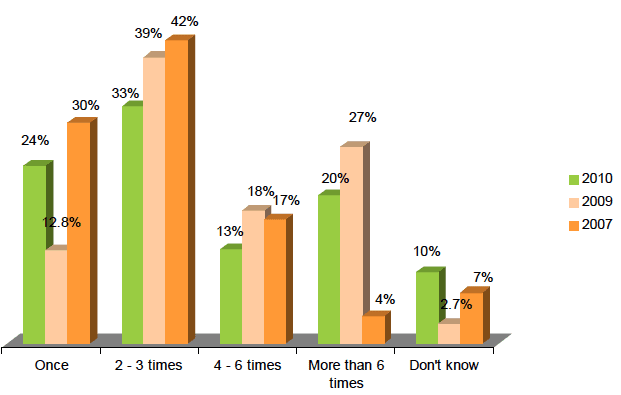
The research from the DMA highlights that 17% of companies are still sending 4-5 emails a month to their contacts,  8% 6-8 times and 8% more than 8 times a month.

On the other hand, frequency can be too low and companies still need to be careful, as too little contact is not good for brand awareness. In 2015 25% of respondents were sending just one email per month to each contact.

Of course, this data is cross-sector, so we would expect some types of businesses such as retailers and publishers to email at least weekly, possibly daily. The research also doesn’t show the effect of lifecycle emails like welcome emails, personalisation, and dynamic content which can help make content more relevant and contextual, but can increase email frequency for subscribers showing content.

Q. What is the best email frequency to maximise response?

Is there an optimal email frequency? Is it one email a quarter, week, month or day even? Is less more or or is more more?!

This is a basic question every digital marketer has to try to answer to maximise profit or response of email activity. I thought I’d share some some testing suggestions and case studies which could help you decide.

Average UK Email Frequency

Compare this to the original research when I wrote this post way back in 2010 when I wrote the conclusion for the UK DMA National client benchmark report. The question here was: What is the maximum number of times you contact an address on your list in one month?

Evaluating current email frequency and customer response behaviour

The first step to answer this question is to assess the impact of your email marketing frequency on customer activity and perceptions. If frequency  is too high, subscribers will tune out. The obvious thing to measure is aggregate open and click rates and most email broadcast systems are good at this. Mark Brownlow has a good roundup of research on customer perceptions of email frequency. In one study 73% said that frequency was the main reason for opting out. Ouch!

Another measure is to look at the average of number of emails you and your competitors send to subscribers per week, month or year.

But you need to go beyond this and use these measures that most systems can’t measure readily, so you need to do some more analysis to identify:

  • Average frequency of email received and plot profile by frequency for different list members - to see the proportion of the list who are receiving too many or two few emails - see chart.
  • List activity - The % of your list that open, click and buy within a period, e.g. quarterly or annual.
  • Recency of response - what is the average for the last open, click or purchase - a good  tip is to store recency in your email database as a field for analysis. Alternatively score list members by activity and store this in the database also.
  • Break down list activity and recency measures by different type of list members - it may the frequency is working for some segments but not others.
  • Break down list activity by time on list - commonsense suggests, that the longer they are on your list, the less responsive your emails will become

Testing options to decide on the best email frequency

It’s not an easy question to answer by gut instinct, so you have to test. So how do you decide on frequency? Here are some ideas and examples showing how you can approach frequency testing:

Defining a random control group to test frequency changes against. Here you continue with current mailing frequency for the control group and then vary the frequency for other groups and review changes in response and in particular revenue per 1000 subscribers. In one case a bank tried frequencies of 1,2,3,4 times per month and found the right frequency this way.

Example 1 Toptable

Sean Duffy reported how Toptable measured the long term impact of increased frequency by creating a control group with half the new customers that joined in a month held back from the second send.

After three months this control group was measured against those who had joined the site at the same time yet received the default setting of two emails a week. Open rates were 86% higher, unsubscribe rates 57% lower.

But the main figured that proved why sending too many emails leads to long term damage - those receiving only one email a week had made 14% more bookings than those receiving two emails over that three month test period!

Example 2 Net-a-porter

In this case Fashion e-retailer Net-a-Porter.com reduced the number of emails it sendt to customers from up to 10 per week to two according to Brand Republic.

It had been emailing some customers up to 10 times a week with information including generic updates, highlights from specific designers and details of new products.

After the experiment Net-a-Porter.com now sends each user two automatically generated emails a week that take into account their specific interests and preferences. Conversion rate has increased. Product update emails get a conversion rate of more than 10% and newsletter emails are opened by nearly half of recipients.

The report also shows the importance of getting email marketing frequency right. The company sends out around 300,000 emails a week. Email drives 32% of Net-a-Porter’s sales and generates more than £1m in revenue each month.

If you have a single email newsletter as in the Toptable example, testing is more complex than these examples suggest since there are a range of different types of emails such as enewsletters, promotional offer emails and also individually tailored event-triggered emails. Different offers or creative to each segment will also be overlaid upon this.

Other options to solve the frequency dilemma include:

A. Reduce Email frequencies automatically for lower responding customers? Set a database field for activity or engagement level for each customer to help implement this. Amazon is good at implementing this and increases frequency through event-triggered emails sent in response to someone browsing, searching or buying - this is the smartest approach.

B. Change frequency for different segments. One frequency size is never going to fit all. So if you find that open or click response is lower for certain segments, then decrease the frequency when they are inactive.

C. Give customers a choice on frequency. You do this through their profile or ”'communications preference centre". Give options to change content and frequency preferences through profile or survey (E-mail, DM)?

D. Increase Direct Mail or SM for customers with a lower Email response. This is sometimes called “right channeling". To test the value of this use a holdout group. This small group, perhaps 5% of your list or a specific segment who doesn’t receive the catalogue (or email if you’re testing this) at all.

E. Re-engagement campaigns.  Re-activation campaigns use content or discounts to encourage email subscribers to become active again.

I’d be interested to hear what you think where you’ve tested this, or what you feel is too high a frequency in a sector.


from Blog – Smart Insights http://www.smartinsights.com/email-marketing/email-communications-strategy/best-frequency-for-email-marketing/

via Tumblr http://euro3plast-fr.tumblr.com/post/161353256214

Adobe Named a Leader in the Forrester Wave Report on Data Management Platforms (DMP)

We’re proud to announce that Adobe was named a leader in “The Forrester Wave™: Data Management Platforms, Q2 2017” report published today. This marks the third consecutive DMP wave report in which Adobe Audience Manager was recognized as a leader.

The marketing landscape has evolved rapidly since the original DMP Wave was published in 2013. Consumer behavior and their expectations have shifted over the course of the past decade as the proliferations of media channels, mobile devices, smart home systems, and VR sets indicate. In this connected world, it’s become critical that brands and publishers understand their customer and deliver delightful experiences at every turn.

At it’s heart, Adobe Audience Manager, Adobe’s DMP, has led the way for marketers to adapt to this new paradigm. The DMP has evolved from powering audience-based experiences in programmatic platforms, to becoming the hub of customer intelligence and audience activation for enterprises around the globe.

As noted in “The Forrester Wave™: Data Management Platforms, Q2 2017” report: “Adobe is a smart choice for marketers focused on extending control across channels…….Adobe was a DMP Forrester Wave leader in 2013 and 2015, and continues to set the pace in this Forrester Wave. More than 84% of its customers appreciated Adobe’s professional services, segment creation and management capabilities, data security and leakage prevention, custom report creation, and user privacy capabilities.”

We believe that our role at Adobe is to empower marketers across industries to thrive as experience driven businesses, by providing best in class solutions coupled with powerful integrations across our technology stack. It’s with pride that we see Forrester recognize Adobe Audience Manager with scores of 5 out of 5 in 27 criteria including: Data ingestion, sync prioritization, and syndication, data analysis, and corporate strategy.

We’re honored to receive this recognition and see it as further validation of our strategy — to enable our customers to become experience businesses with the help of Adobe Audience Manager. Learn more by reading our press release.

The post Adobe Named a Leader in the Forrester Wave Report on Data Management Platforms (DMP) appeared first on Digital Marketing Blog by Adobe.


from Digital Marketing Blog by Adobe https://blogs.adobe.com/digitalmarketing/digital-marketing/adobe-named-a-leader-in-the-forrester-wave-report-on-data-management-platforms/

via Tumblr http://euro3plast-fr.tumblr.com/post/161351856479

Point of Sale: Retail & Travel Weekly

This week’s articles review variances among micro- and macroconversions for retailers, a study claiming nearly one-half of mobile sessions start without users having clear ideas of which apps they want, ways hypotheses can optimize site conversions, and more.

The post Point of Sale: Retail & Travel Weekly appeared first on Digital Marketing Blog by Adobe.


from Digital Marketing Blog by Adobe https://blogs.adobe.com/digitalmarketing/news-and-resources/point-sale-retail-travel-weekly-44/

via Tumblr http://euro3plast-fr.tumblr.com/post/161350421734