Friday, 2 June 2017

Email marketing and Enewsletter systems and software reviews 2017

Our recommendations and reviews on email marketing broadcast software options

Since I delivered one of the first training courses on Email marketing in 2001, I have regularly been asked for recommendations for affordable E-mail broadcast software packages for Email marketing and sending Enewsletters. Today, email services are far more sophisticated when I first became involved with Email marketing 15+ years ago. The main changes are:

  • All Email services have some features of Marketing Automation including dynamic content, automated email sequences based on actions and lead-scoring scoring based on content interacted with (particularly important for B2B Email marketing)
  • Many email services are now part of broader ‘Marketing Cloud services’ particularly relevant for larger businesses. These are covered in our enterprise marketing cloud review

This post highlights some of the options for businesses of different sizes that are most commonly used in the UK and delegates on my E-mail marketing courses have recommended to me. It’s an informal post I originally started on a previous site in 2005 to point marketers on courses to for a shortlist of suppliers to review and I’ve added to it and removed sites over the years. It also includes recommended reviews site.

I always recommend hosted (Email Service Provider or ESP, or SaaS) email marketing solutions rather than software since, in general, the reporting/tracking and bounce management capabilities of the cheaper desktop e-mail packages are inferior. There are also management problems with deliverability and blacklisting which are best managed by an external email service provider in my opinion.

Although you can use an email service provider in another country, I recommend using a local provider since this is easier for support and resolving deliverability problems locally. So I have highlighted UK Email marketing companies at the start of the list, but options for US and Asia Pacific are also covered.

The E-mail broadcast / management (E-mail Service Provider, ESP) solutions which are most cost-effective (below $50 per month for low volumes) recommended to me by delegates on my courses are as follows. I have grouped them by region, since often, local support is useful to deal with local deliverability issues.

2017 update: Free Email Marketing RFP Guide

Since I originally created this comparison around ten years ago I have updated it with new Email marketing services available in different countries which can give better local support.

Choosing the best email service provide can be challenging since there are so many features. Although some providers may offer 'Marketing Automation’, there are many features within that. To help here we offer members now able to offer this downloadable checklist of features to look for when choosing an email - it’s free to all members on Smart Insights.

Since this post was originally posted on my blog 10 years ago, there have been huge changes in functionality of email systems. So in 2016, many Email marketing providers have expanded their services to include broader Marketing Automation features and Marketing Clouds that cover marketing communications across the full customer lifecycle. If you want to learn about our top recommendations in these categories see our Digital Marketing Tools 2017 checklist, available as a free download to all Basic members.

Services comparing Email Marketing Software

Use publisher sites to compare criteria for email marketing systems side-by-side

In the next sections we have recommendations of ESPs we’re familiar with who have local support which can be vital for timely response and knowledge of local deliverability issues.

Popular UK-based Email marketing systems most suited for small and medium businesses

  • NewZapp - a relatively low cost, capable UK-based solution
  • dotMailer - another cost-effective UK solution
  • Pure 360 - UK-based Email marketing specialists with options for SMEs and larger companies wishing to run trigger-based personalised Email marketing campaigns
  • Newsweaver - Offices in UK and Ireland with clients ranging from large multinationals to SMEs. Have examples of SMEs Email templates on their site
  • CommuniGator - a service focused on B2B Email marketing and Email marketing automation

European-based ESPs

Enterprise email service providers and Marketing Cloud providers with UK offices

These focus on providing services for large brands with complex needs of systems integration, higher quality support and delivery of services in different countries. Companies I have worked with in the UK at training days for their clients include:

Popular US-based Email broadcast services

  • MailChimp (US email service often recommended for its ease of use)
  • Constant Contact (again US-based but used widely in Europe)
  • Benchmark Email (a US-based email marketing platform with offices in Europe and worldwide). They differ from some of the other providers since along with ease-of-use and affordability, personalised support is included in all plans.

Asia Pacific Email management systems

Of course, there are literally hundreds of E-newsletter broadcast solutions and these represent the most widely used lower-cost options.

Key criteria to consider for an Email or Enewsletter system are - can the solution:

  1. Track E-mail response at an individual level? Essential for follow-up?
  2. Create automated email sequences for event-triggered or behavioural emails?
  3. Integrate with actions on a websites, e.g. search or browse a product category?
  4. Track campaign response across time / multiple campaigns?
  5. Integrate response with customer database?
  6. Manage profiling and subscription/unsubscribe?
  7. Bounces, e.g. Out-of-office auto-replies?
  8. Deliver WYSIWYG editing for marketing staff?
  9. Archived e-newsletters on web site?
  10. Is broadcasting straightforward?

Please add your comments on other systems or suppliers you can recommend, or not!


from Blog – Smart Insights http://www.smartinsights.com/email-marketing/email-list-management-ecrm/email-marketing-enewsletter-systems-and-software/

via Tumblr http://euro3plast-fr.tumblr.com/post/161348478809

Connecting Industry and Academia: A Bright Future for Data Science?

The post Connecting Industry and Academia: A Bright Future for Data Science? appeared first on Digital Marketing Blog by Adobe.


from Digital Marketing Blog by Adobe https://blogs.adobe.com/digitalmarketing/digital-marketing/connecting-industry-academia-bright-future-data-science/

via Tumblr http://euro3plast-fr.tumblr.com/post/161346898544

Email marketing statistics 2017

The best email statistics sources to benchmark open and clickthrough rates for your email campaigns in the UK

Email marketers often ask “how do our campaigns compare”? They’re looking for statistics to compare subscriber engagement for open, clickthrough and delivery rates, ideally within their sector.

Fortunately, there are a number of good options to benchmark email response across different sectors. The best stats sources are compilations by email marketing service providers who produce statistics across their clients’ campaigns. We have ordered them into the 4 top questions asked:

As we’ll see, for the most meaningful comparisons we need to go beyond industry averages and drill down to the comparison of email types since transactional emails such as a welcome sequence tend to have much higher interaction and click-through rates than a regular newsletter.

Email Statistics - 2017 update

Q1. What are the email engagement rates for small to medium businesses?

We will continue to update this resource through the year as new reports are produced by the main email platforms. Do contact us if you’re an email provider with new stats to share. Talking of which… Mailchimp has monthly updates of their Email benchmark stats which give a great source of comparing email response by industry. This Email response data has been updated on 1st February 2017.

Open Open rate (%) Clickthrough rate (%) Soft Bounce Hard Bounce Abuse Unsub
Agriculture and Food Services 24.71% 2.98% 0.58% 0.43% 0.02% 0.29%
Architecture and Construction 24.78% 2.90% 1.50% 1.08% 0.03% 0.36%
Arts and Artists 27.23% 2.85% 0.61% 0.44% 0.02% 0.29%
Beauty and Personal Care 18.48% 1.96% 0.38% 0.38% 0.03% 0.32%
Business and Finance 20.97% 2.73% 0.66% 0.55% 0.02% 0.23%
Computers and Electronics 20.87% 2.16% 1.02% 0.70% 0.02% 0.31%
Construction 22.10% 1.95% 1.56% 1.20% 0.04% 0.43%
Consulting 19.54% 2.26% 0.92% 0.71% 0.02% 0.29%
Creative Services/Agency 22.41% 2.61% 1.09% 0.89% 0.02% 0.38%
Daily Deals/E-Coupons 15.22% 2.39% 0.10% 0.07% 0.01% 0.10%
E-commerce 16.75% 2.32% 0.30% 0.24% 0.02% 0.23%
Education and Training 22.00% 2.63% 0.55% 0.46% 0.02% 0.20%
Entertainment and Events 21.21% 2.33% 0.49% 0.41% 0.02% 0.28%
Gambling 18.75% 3.35% 0.39% 0.46% 0.03% 0.17%
Games 20.82% 3.33% 0.44% 0.50% 0.02% 0.25%
Government 26.33% 3.62% 0.48% 0.39% 0.01% 0.13%
Health and Fitness 21.93% 2.57% 0.43% 0.44% 0.03% 0.39%
Hobbies 28.46% 5.13% 0.31% 0.24% 0.02% 0.23%
Home and Garden 23.82% 3.47% 0.57% 0.40% 0.03% 0.37%
Insurance 21.56% 2.11% 0.76% 0.82% 0.03% 0.26%
Legal 22.49% 2.99% 0.76% 0.67% 0.02% 0.23%
Manufacturing 21.74% 2.33% 1.41% 0.99% 0.03% 0.36%
Marketing and Advertising 17.81% 1.92% 0.77% 0.61% 0.02% 0.28%
Media and Publishing 22.14% 4.70% 0.28% 0.18% 0.01% 0.12%
Medical, Dental, and Healthcare 22.43% 2.42% 0.72% 0.72% 0.03% 0.30%
Mobile 19.43% 2.10% 0.57% 0.63% 0.02% 0.36%
Music and Musicians 22.86% 2.84% 0.56% 0.42% 0.02% 0.29%
Non-Profit 24.98% 2.76% 0.49% 0.40% 0.02% 0.19%
Other 23.06% 2.81% 0.78% 0.60% 0.02% 0.28%
Pharmaceuticals 20.02% 2.51% 0.79% 0.74% 0.02% 0.22%
Photo and Video 25.36% 3.49% 0.71% 0.61% 0.02% 0.40%
Politics 22.23% 2.17% 0.42% 0.38% 0.03% 0.21%
Professional Services 20.89% 2.47% 0.92% 0.72% 0.02% 0.31%
Public Relations 20.12% 1.64% 0.80% 0.60% 0.01% 0.21%
Real Estate 20.84% 1.91% 0.61% 0.51% 0.03% 0.31%
Recruitment and Staffing 20.73% 2.18% 0.53% 0.60% 0.02% 0.32%
Religion 26.46% 3.11% 0.19% 0.17% 0.01% 0.13%
Restaurant 21.17% 1.25% 0.24% 0.22% 0.02% 0.26%
Restaurant and Venue 21.71% 1.33% 0.53% 0.45% 0.02% 0.42%
Retail 20.96% 2.50% 0.35% 0.30% 0.02% 0.28%
Social Networks and Online Communities 21.71% 3.33% 0.37% 0.29% 0.02% 0.23%
Software and Web App 20.95% 2.29% 1.06% 0.85% 0.02% 0.39%
Sports 25.41% 3.19% 0.46% 0.41% 0.02% 0.29%
Telecommunications 21.57% 2.43% 1.13% 0.92% 0.02% 0.27%
Travel and Transportation 20.69% 2.17% 0.65% 0.48% 0.02% 0.24%
Vitamin Supplements 17.26% 1.80% 0.28% 0.22% 0.03% 0.25%

We do have other industry sector breakdowns of response later in this post, but since Mailchimp send billions of emails a month for more than 10 million users this is probably the largest global sample of email response that has been created. It is skewed to smaller businesses using their free account options, though.

Q2. What are the Email engagement rates for larger businesses?

The results for Mailchimp are more typical of smaller and mid-size businesses, rather than large brands. This 2016 email benchmark compilation from Silverpop who are now owned by IBM so clients tend to represent larger businesses - they are from 750 companies representing 3,000 brands in 40 countries. So breakdowns by EMEA, UK, US and APAC are available too. I’ve selected the breakdown by industry which is more useful to compare your performance with.

But what is the average email open rate? Here are the open rates with the mean showing the variation from the poorest performing sectors like publishing and tech to consumer brands and non-profits.

Email open rates by industry

Rather than click-through rates that are also available in the report, I have picked out Click-to-open which shows engagement with the copy and creative. As a rule of thumb you should look for 10 to 15% CTOR, so can compare emails against this benchmark.

Click to open rate by industry

Finally, from this benchmark, I thought it would be useful to share the data on list churn as indicated by hard bounce rates and spam complaint rates. You don’t want to go too high on these since you could have a problem with inbox delivery and likely your ESP will get in touch.

Unsubscribe rate for email campaigns by country or region

Email complaint rate by country or region

Q3. What is the breakdown of market share for email clients on mobile and desktop?

Litmus, one of the best sources for stats on Email marketing has produced a Jan 2015 update reviewing the current situation to previous years.

This chart summarising their research. While mobile remained dominant, this year did see some changes for mobile, webmail, and desktop.

Market share 2016 - Desktop, Mobile and Webmail

The latest Litmus compilation of email client market share from January 2017 shows why it’s so important to consider how well your emails render on mobile. It’s based on the percentage of opens on different platforms. The uptick in webmail opens is again largely due to Gmail defaulting to open images.

Compilation of email client market share

View post on % reading emails on mobile devices.

Litmus also has additional data aggregating Mobile clients - see their Email marketing client market share site for the latest updates. This shows the need to optimise for the iOS and Android platforms, bit with Android surprisingly low compared to the iPhone.

Mobile email opens

Q4. What is a good open rate? And what is a good click through rate for email?

Across all industries, the average open and clickthrough rate results according to the most recent Sign-up.To Email statistics for UK SME email marketing campaigns were:

Open and click-through rate by sector

Across all industries the average results for UK SME email marketing campaigns were:

  • Open rate: 24.79% (2016: 24.88%)
  • Click-through rate: 4.19% (3.42%)
  • Unsubscription rate: 0.49% (0.52%)
  • Click-to-open rate: 11.88% (10.88%)
  • Unsubscribe-to-open rate: 2.59% (2.72%)

This data shows that open rate has had a slight decrease, click-through and click-to-open rates have slightly increased. While unsubscribe-to-open rates showed a slight decrease.

The 2017 report has a relatively small sample of 1.5 billion emails sent by SMBs during 2016.

But it’s a useful report since it has the breakdown of opens, clicks and unsubscribes by industry for B2B and B2C markets. This shows the much lower response in some sectors such as Events, Education and Legal services.

There are also statistics on engagement measured as clicked to open - this info isn’t always available in these types of benchmarks. It’s useful to compare how effective your creative and offers is at to generating clickthroughs.

Click-to-open rate by sector

Finally, the full report also has a sector breakdown on unsubscribe rates. Again a large difference here by sector.

Unsubscribes by sector

In the Autumn of 2015, we partnered with Email marketing platform GetResponse to benchmark adoption of email marketing techniques. As part of this project, GetResponse has now published one of the first benchmarks comparing email open and clickthrough rates by industry sector. The chart shows that email marketing is considerably more challenging in some sectors such as retail and e-commerce, marketing services and travel compared to others such as financial services and consumer sectors.

Global Open and clickthrough rate Email statistics 2016

You can download the full State of Email marketing 2016 by industry from the GetResponse site - the 2017 update will be released by April 2017.

 Please let us know of other sources we can share in updates here. Thanks!


from Blog – Smart Insights http://www.smartinsights.com/email-marketing/email-communications-strategy/statistics-sources-for-email-marketing/

via Tumblr http://euro3plast-fr.tumblr.com/post/161346499714

Thursday, 1 June 2017

Which websites influence B2B Purchase decisions?

Offline information sources remain important, supplemented by new online sources

High-value B2B purchase decisions are typically complex, involving multiple decision makers. They often involve interactions with sales staff to check the fit between product and service and what the client is looking for. Higher in the funnel, when purchasers are comparing the features of suppliers they will use multiple sources.

This research from Global Web Index across a large sample of B2B buyers show the range of information sources that are used. These include both traditional sources such as sales presentations and direct mailing which remain important and newer techniques. For example, communities created by the business or independent communities are surprisingly important. Company pages are on social media are also used are slightly more important that trade ads today.

The chart doesn’t clarify ‘relevant industry website’, we can assume this includes both supplier sites and specialist industry news sites. 'News story’ is the second most popular source showing the importance of technical publishers in explaining the options in buying decisions.


from Blog – Smart Insights http://www.smartinsights.com/b2b-digital-marketing/b2b-strategy/websites-influence-b2b-purchase-decisions/

via Tumblr http://euro3plast-fr.tumblr.com/post/161317508464

Email segmentation and targeting options

Learning from 6 layered targeting options used by online retailers that can be applied to any business

There are many different levels in sophistication of targeting for email marketing. In this post I’ll run through some of the most common examples used by retailers since I think they can often be applied to companies who don’t sell online like relationship-building or B2B companies.

Here, I will outline what I see as the 6 most common segmentation approaches. More details are available in my book Total Email Marketing and my more recent 7 Steps to Email Marketing Success Ebook on Smart Insights.

Although this post gives email marketing examples, the segmentation approaches here can be used to other forms of online targeting through digital marketing, particularly website personalisation or display ad network remarketing.

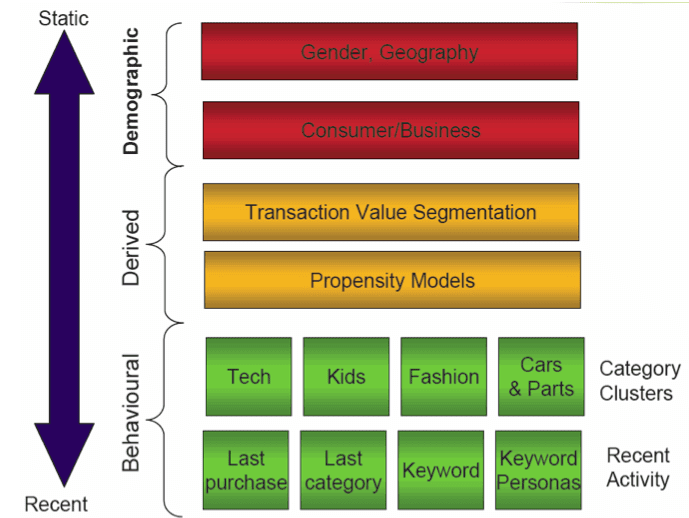
Often the different targeting options can be combined through layering the segmentation as shown in this approach used by eBay UK shared at a recent email marketing conference:

To implement this level of email marketing needs a capable email marketing system that supports event-triggered marketing and dynamic content insertion where rules are used to drop different offers and email messages into a container as described last week’s post on how to manage event-triggered or automated email marketing.

These are the six targeting options.

  • 1. Customer profile characteristics (demographics).
  • 2. Customer value - current and future.
  • 3. Customer lifecycle groups.
  • 4. Customer behaviour in response and purchase (observed and predicted).
  • 5. Customer multi-channel behaviour (channel preference).
  • 6. Customer personas including psychographics

Targeting option 1. Customer profile characteristics (demographics)

This is where most will start, based on their traditional segmentation based on the type of customer recorded in the fields of the customer profile.

For B2C e-retailers this will include age, sex and geography. For B2B companies, this will include size of company and the industry sector or application they operate in. Here’s an example:

Many B2B companies target according to industry sector, but do not also look at job role.

Targeting option 2. Current and predicted value

Retailers work hard to understand their most valuable customers so that they can develop loyalty in this group. A useful way of thinking about customer value is these three groups, originally identified by Peppers and Rogers of  1 Most-valuable customers (MVCs), Most-growable customers (MGCs) and Below Zero Customers (BZCs). When considering loyalty-based segmentation, it’s useful to compare current against future value, and it’s best to visualise this within a matrix.

Here is one way you can analyse value using a real example from retailer group Otto presented by Chris Poad their Ecommerce Director at an Econsultancy Masterclass. It’s actually more sophisticated than simple value in that it looks at a range of indicators of quality.

Here’s a creative example for a VIP Mailing sent to highest value segment. ESP eCircle shared that the average performance was 5 times higher than the regular newsletter:

Option 3. Targeting by customer lifecycle groups

As visitors use online services they can potentially pass through several stages, often known as the online loyalty ladder. For many e-retailers, encouraging customers to move from the first purchase to the second purchase and then onto the third purchase is a key challenge. Specific promotions can be used to encourage further purchases. Similarly, once customers become inactive, i.e. they have not purchased for a defined period such as 3 months, they become inactive and further follow-ups are required. Here’s an example of the lifecycle segmentation approach used by e-retailer Tesco.com which they call a “commitment-based segmentation” based on recency of purchase, frequency of purchase and value. It’s used to identify 6 lifecycle categories which are then further divided to target communications:

  • Logged-on
  • Cautionary
  • Developing
  • Established
  • Dedicated
  • Logged-off (the aim here is to winback)

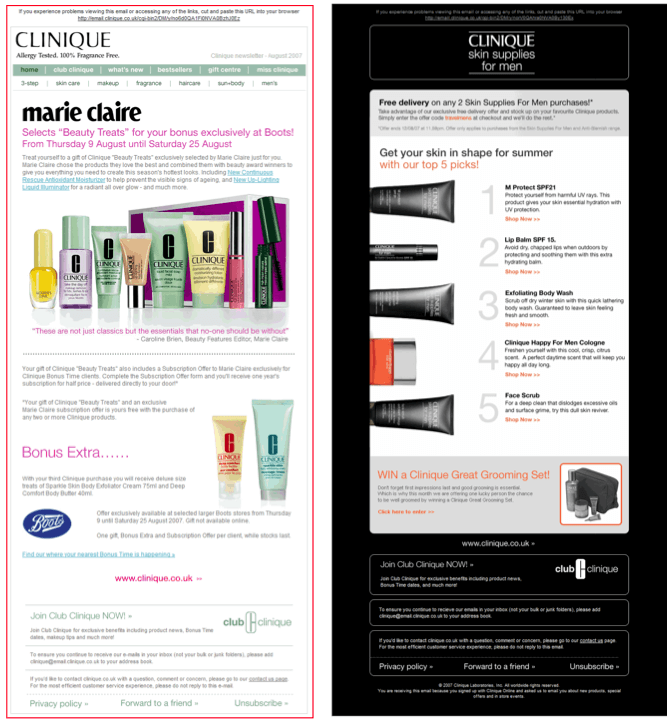
This is an example of what I think is an excellent branded welcome email from Clinique:

Targeting option 4. Current and predicted behaviour in response and purchase

As customers progress through the lifecycle, if all interactions with different communications such as email clicks and pages visited on site are captured, we’ll be able to build up a detailed response and purchase history.

Developing an activity score to show levels of customer activity or how “hot” they are to respond is one approach.

A more sophisticated method of understanding behaviour is to categorise customers according to the details of their recency, frequency, monetary value and category of products purchased (RFM analysis). The RFM technique is quite involved, so we will cover that in more detail in a moment.

Using these RFM techniques in combination with the other targeting techniques it becomes possible to use predictive modelling to identify the “Next Best Product” for particular customer types. With the right system of tracking and web analytics, it should be possible to see not only which types of links in an e-mail a customer has clicked upon, but also which types of web pages they have visited recently. For example, a Select on the database for a wine promotion could be used to target customers who have been to the wine section of the website in the last 3 months, but have not purchased wine.

Targeting option 5. Multi-channel behaviour (channel preference) = Right Touching

No matter how enthusiastic you are about online channels, some customers will prefer using online communications channels and many others will prefer traditional channels. I call this Right Touching - this is the holy grail of digital marketing - delivering the perfect message for each customer. Just one aspect of this is determining which customers prefer email and then up-weighting email activity more for them, while reducing frequency and using more traditional communications for those who prefer these. These days we will also need to consider social media response.

So it’s useful to have a flag within the database which indicates customers’ channel preference and by implications, the best channel to target them by.

Channel preference will be indicated by RFM and response analysis since customers with a preference for online channels will be more responsive and will make more purchases online. Customers can also be asked direct through surveys.

Customers that prefer online channels can be targeted mainly by online communications such as e-mail, while customers who prefer traditional channels can be targeted by traditional communications such as direct mail or phone.

To deliver relevance also requires a plan specifying the number, frequency and type of online and offline communications and offers. This is a contact or touch strategy which is described in a later section.

Targeting option 6. Customer personas including psychographics

Once we have reviewed and selected from the five targeting approaches above, it a final step to review using marketing personas for typical customer types.

These have the benefit that the characterise segment types in the context of the targeting options mentioned above such as stage in lifecycle, demographics and style preferences.

The design persona concept can also potentially be used for e-newsletters, but isn’t used so often.

I’d like to hear about how personas can be used for email marketing, or your thoughts on any of the other targeting options listed here.


from Blog – Smart Insights http://www.smartinsights.com/email-marketing/email-targeting/email-segmentation-and-targeting-options/

via Tumblr http://euro3plast-fr.tumblr.com/post/161316046019

Reverse Engineering Influencer Identification on Instagram

Engage the right influencers to get results from your Instagram marketing

When Kevin Systrom and Mike Krieger set out to create what we now call Instagram less than a decade ago, they just wanted to make a simple photo and video-sharing app. What they never anticipated is what Instagram has evolved into—a top marketing platform that has attracted startups and top global brands alike.

The spoil is an immense consumer audience that recently hit the 700 million mark. Instagram’s response was decisive through ad campaigns in the mould of sponsored posts tailored for specific target audiences.

Quite evidently, the owners of Instagram have not been the only parties to tap into the incredible financial benefits from advertisements. The meteoric rise of Instagram as a marketing tool has overseen an equally remarkable rise of Instagram influencers who can be likened to online marketing executives. In fact, currently, up to 12% of Instagram influencers earn a living primarily from the role they play as influencers!

Just who are these Instagram influencers? They are influential personalities, mostly celebrities, on Instagram with a significant audience that looks up to them. Studies have shown that the purchasing decisions of the modern consumer, especially among the millennials, are highly influenced by their favorite personalities on Instagram. This new crop of consumers is easily swayed by posts and comments on social media. Therefore, any content coming from influencers is likely to gain a lot of traction with their followers.

Influencer marketing, as a strategy, is about building a relationship with these influencers as a pathway to their audience base. The objective is to tap into their influence to build your brand or market your products. It is also about driving traffic to your page in order to foster engagement with potential customers.  Finally, it is akin to implementing a word-of-mouth marketing strategy on social media.

That said, employing influencer marketing as a marketing tool on Instagram must be strategic and methodical. The first, and arguably the most crucial step, is identifying the right influencer. It is not just about the size of their following. It is all about recruiting influencers with the right audience. That is why it works in the reverse. You have to determine your target audiences before you identify the influencer with the right mix. The process can be painstaking. Grin.co has created an Instagram search specifically designed for that purpose; eliminating the guesswork of finding the key influencers with targeted audience demographics that align with your brands voice.

Once you have the right influencer with your target audience, the next step is to use them to attain the goals of your marketing strategy on Instagram. You can work with them to:

Reach a New Audience

This is the primary reason why you need them. They will help you gain instant access to an audience that could take you ages to build. That way, you will get an opportunity to sell your brand to the right audience within a short time.

Promote Engagement

Reaching a larger audience is not enough if no engagement or interaction is created with your brand. Creating engagements makes people talk about your brand or products and, in effect, recruits them into your marketing campaign.

Gaining More Followers

Influencers can help you gain new followers easily by directing traffic to your page. When their audience is impressed with your brand or what you have to offer, they will most certainly visit your page and follow you.

Conclusion

In summary, influencer marketing is rapidly overshadowing conventional marketing techniques and their influence cannot be ignored in an age where the social media is the new marketplace. The keys to a success influencer marketing campaign in Instagram are these: understand your target audience and engaging the right influencer.


from Blog – Smart Insights http://www.smartinsights.com/social-media-marketing/instagram-marketing/reverse-engineering-influencer-identification-instagram/

via Tumblr http://euro3plast-fr.tumblr.com/post/161311386094

The Marketing technology Landscape in 2017 [Infographic]

6 implications for selecting and managing today’s and tomorrow’s marketing technology

We’ve been sharing the latest Marketing Technology Landscape map by Scott Brinker, @chiefmartec for several years now. You’ve almost certainly seen one of the earlier iterations since it has been widely shared. I love it because it’s a USEFUL infographic - it prompts marketers to review their current Marketing Technology and take action to improve their Marketing Technology Stack.

When I discuss it with marketers when speaking or training, it certainly has a big impact, not always in a good way… It prompts that “OMG how do I cope?” fear amongst marketers and business owners due to its complexity. But, for me, it shows the opportunity of the many tools we have available to deliver more relevant, more personalised communications today. It’s inspired the Smart Insights team to create our own Martech infographic which includes both insight and operational tools across our RACE planning framework. We also have another post looking at auditing the Martech stack which includes another Scott Brinker framework - the 6C categories of Marctech.

Our ’Essential Digital Marketing Tools’ infographic aims to show the choice in martech today in a different way since it differs from Scott Brinker’s awesome infographic in that it is:

  • Simpler - fixed in size and  structured around our RACE marketing management framework
  • More practical - Blending tools which give marketing insight with marketing operations management tools
  • Less corporate - it focuses recommendations of free, low-cost tools but also will include ‘enterprise technologies’

So, that’s our tool, but you will be wanting to see the latest version, with 5000 different tools, DRUMROLL, here it is…

You can click on the graphic above to expand, as it is too large to be able to see individual logos.

If you want the hi-res 30Mb version, see Scott’s post: Marketing Technology Landscape (2017).

It’s great Scott has the passion to update this each year given the speed at which technology changes. You can see the work involved from the number of new tools he has added each year:

Implications from previous versions of the Marketing Technology landscape

Here, for comparison is the 2015 Marketing technology landscape infographic which we think provides a great framework to help managers think through the best technology to improve their marketing and to review the leading technology vendors in each category.

marketing technology services 2015

It’s a retina-burning infographic, which doesn’t look great on a blog or on a printer, but if you click to expand you can see its value and impact - it prompts you to ask “How do we make sense of this - what does it mean for us - what should we be using which we’re not currently?!” There’s good categorisation of all the tools too.

How do you find this? Is it scary to you because of the potential expense and business case preparation? Not to mention the challenges of managing implementation and integration of these systems. Or is it an opportunity to use technology to compete and create more relevant engaging customer experiences than your rivals.

The tool is useful in its own right, but I think it’s useful to prompt marketers to think about how they manage the complexity and range of options in technology which I explore in this post.

Categories of marketing technology

The first implication of this “infographic like no other” is that when you’re reviewing your approach to using technology, it’s useful to audit your technologies across these 6 categories and the 42 subcategories

categories-of-marketing-technology

The six main categories to review are described like this by Scott:

  1. Marketing Experiences — more specialized technologies that directly affect prospects and customers across their lifecycle, such as advertising, email, social media, SEO, content marketing, A/B testing, marketing apps — the “front-office” of modern marketing.
  2. Marketing Operations — the tools and data for managing the “back-office” of marketing, such as analytics, MRM, DAM, and agile marketing management.
  3. Marketing Middleware such as DMPs, CDPs, tag management, cloud connectors, user management, and API services.
  4. Marketing Backbone Platforms such as CRM, marketing automation, content management, and e-commerce engines. [These are quite different in their application, so need to be reviewed separately].
  5. Infrastructure services such as databases, big data management, cloud computing, and software development tools.
  6. Internet services such as Facebook, Google, and Twitter that underlie today’s marketing environment. [How you integrate with these key platforms]

Selecting the best marketing technology

Beyond this, there are many other implications about how you select technology or make recommendations to your clients. The answers will vary a lot by type and size of company, but the implications are similar. Technology is a significant marketing investment, so it needs a structured, not piecemeal approach.

  • 1. A solid business case and review approach is needed. Define a process and template for technology business case that avoids wastage and duplication and prioritises the technologies that will give the biggest returns. In larger companies this needs to be centralised to a great degree to avoid maverick purchases.
  • 2. A technology roadmap is required as part of digital strategy. Starting from scratch, it would take years to implement these technologies. A technology roadmap helps prioritise and make it achievable.
  • 3. All-in-one vs Best-of-breed solutions. One approach to reduce complexity is to use all-in-one solutions such as the Marketing Cloud services that many of the large technology companies like Oracle, Salesforce and Adobe are now offering. But these may be overkill for some businesses who may be best using simpler tools, for example, an email service provider rather than a full-blown marketing automation system.
  • 4. Open source options can give significant savings. Open source can give significant savings in some areas such as content management or video hosting. But savings in licensing need to be offset against potential lack of support.
  • 5. Businesses need to get the value from their technology investments. Implementing the technology is just the start. If a technology isn’t used by the business to get the value from it, then that’s bad management, not the fault of the technology or vendor.
  • 6. Change management and education are as important as the technology. None of these technologies work without human intervention or intelligence. Customisation is needed, so encouraging ongoing adoption is key, although not all technology vendors support this as well.

Scott also has another post covering the implications for aligning technology and business strategy - showing how the two are intertwined (option c) rather than a top-down approach of business or marketing strategy and then find technology to support it (option a). So you need an element of both - Option b) shows that technology should impact strategy to help gain competitive advantage


from Blog – Smart Insights http://www.smartinsights.com/managing-digital-marketing/marketing-innovation/marketing-technology-2014/

via Tumblr http://euro3plast-fr.tumblr.com/post/161309540319