Wednesday, 31 May 2017

If You Want Customer Referrals, Start Building Relationships

How influencer and affiliate marketing can work in tandem to win you more loyal customers

In life and in marketing, it’s always tempting to create dichotomies: those who like piƱa coladas and getting caught in the rain and those who don’t, for example.

But times have changed, and technology has fundamentally transformed how we consume information and make decisions. Even Jimmy Buffett isn’t taking out personal ads in the newspaper anymore, just as consumers are no longer waiting for brands to give them the information they want.

Instead, people have access to instant information at the click of a button. Through social media, they can also post to large followings, whip up their own movements, and educate themselves — all before reaching out to brands.

These changes mean marketers need to constantly think about how to engage and connect with consumers. Plus, they need to avoid false dichotomies when it comes to prioritizing who can amplify a brand’s message. Both consumers and influencers can serve as brand champions and give huge boosts to a business. The difference lies in who they are, how they relate to your brand, and how you want to work with them.

Spreading the Message

Unlike your customer base that will sing your praises to personal connections, influencers charge a fee to drive your brand’s message to a larger market. Influencer marketing is simply a modern twist to age-old affiliate marketing. Both influencers and affiliates leverage their network of fans, followers, and readers to share your business in exchange for an incentive.

Regardless of who is spreading your message, word of mouth is the most powerful way for a consumer and brand to establish a relationship. Consumers are also more likely to engage with a brand that leaves an impression, provides an experience, or caters to their passions and interests.

But it’s not just about attracting someone new. Failing to market to or engage with faithful customers represents an opportunity cost in terms of leveraging loyalty. These existing customers can help amplify your branding, image, awareness, and other marketing objectives.

Most brands think influencer marketing is the best way to get their messages out to the masses. And while it’s easy — and tempting — to be seduced by the likes, follows, and shares that come with it, influencer marketing’s real success comes from attracting customers who stick around for the long haul.

This is where customer referral marketing comes in. By giving your existing customers a way to recommend your product and share it with their networks, your brand can increase awareness while generating even more loyal customers and brand champions.

Creating Loyal Relationships

Generating real brand affection requires tapping into the different types of brand champions who can woo other consumers, pique curiosity, and inspire loyalty. There’s room for existing customers, brand ambassadors, and various influencers in this equation. Here’s how to use each relationship to your advantage:

1. Tap into customer referrals.

Referral marketing happens regardless of whether marketers facilitate it simply because it’s natural for us to share experiences with our friends. The key is to ensure those word-of-mouth interactions occur the right way.

Cultivating a steady stream of these referrals takes time but yields a major payoff. Seventy-four percent of consumers identify word of mouth as a key influencer when making purchasing decisions; in addition, the University of Pennsylvania’s Wharton School of Business found that referred customers are 18 percent more likely to stay with a company.

But how do you establish a reputation that warrants these kinds of referrals? Start by setting high standards for your brand and customer service, and put out feelers to monitor how others perceive your work. Set up online alerts for your brand’s name through Google Alerts or Mention, survey your clients about their impressions of you, and keep your ear to the ground on social media.

When you see a customer who seems particularly fond of you, reach out and ask to share his story. Don’t be shy about asking him to spread the word, following up with him, or rewarding his loyalty with tokens of appreciation.

2. Take it to the next level with brand ambassadors

Engaging with existing customers and reaching out to new ones go hand in hand. Your existing customer base is great to leverage when finding folks who are willing to steward your brand and messaging across their networks.

Even if you’re not into yoga, you can appreciate Lululemon’s way of empowering brand ambassadors to run with their vision and build a larger meaning around it. The company started small and then sought out brand ambassadors who were passionate about it and inspired to turn it into a signifier of a luxuriously leisurely lifestyle. Lululemon’s resulting success is about more than yoga pants and $60 tank tops — it’s about a desire for youth, energy, vitality, and health.

As you would with any relationship, decide what you want from brand ambassadorships and what you’re willing to give in return. Sending brand ambassadors some swag or letting them borrow a little brand cachet to help launch their own passion projects will go a long way. Feature ambassadors on your website or blog, and let them link to it from their LinkedIn profiles. Reciprocity can only strengthen the relationship.

3. Make yourself irresistible with influencers.

Using influencers means greater access to a brand-new network, increased brand awareness, and social proof to ease the minds of worried customers.

Recent statistics show that social media influencers have the greatest effect on teens and younger demographics, though more than 80 percent of marketers who have leveraged this tactic report that it has increased engagement and awareness for their brands.

Litter-Robot, a line of self-cleaning litter boxes, benefited greatly by tidying up its approach with affiliates and influencers. It gave brand ambassadors their own unique URLs for sharing, streamlined its coupon-sending, and saw its sales increase by more than 300 percent. The brand sent some extra love to its brand ambassadors and saw impactful results.

Like a man taking out a personal ad only to see his wife respond, brands need to realize that their greatest gifts have been with them all along. Centering existing customers and their word of mouth — whether through customer referrals, brand ambassadors, or social media influencers — is one of the best ways to make loyalty contagious. Marketing their experiences will spread affection for your brand far and wide.


from Blog – Smart Insights http://www.smartinsights.com/affiliate-marketing/affiliate-marketing-strategy/want-customer-referrals-start-building-relationships/

via Tumblr http://euro3plast-fr.tumblr.com/post/161271902544

Tuesday, 30 May 2017

Adobe Advertising Cloud named a leader in Forrester’s Omnichannel Demand-Side Platforms report

More and more often, we hear marketers who work with multiple advertising-technology vendors, complaining about how difficult it is for them to reconcile disparate platforms and efficiently manage their ad-spend across channels. According to the latest Adobe Digital Insights (ADI) “Digital Advertising Report 2017,” 41 percent of marketers work with three or more media-buying platforms, three or more media-planning platforms, and three or more analytics platforms. All these platforms make it operationally challenging for advertisers to manage their audiences’ reaches, de-duplicate conversions in reporting, and efficiently plan their ad budgets across channels and devices.

Many advertisers are realizing that they need fully integrated, cross-channel, media-buying platforms as part of their ad-tech stacks — one platform to rule them all, with unparalleled access to all paid advertising channels.

Adobe Advertising Cloud — One Platform to Rule Them All.
Adobe Advertising Cloud is the first independent, end-to-end platform that unifies lower-funnel performance tactics, such as search and display, with upper-funnel brand tactics like video and TV.

Combining the capabilities of Adobe Media Optimizer with those of recently acquired TubeMogul — a leader in “The Forrester Wave™: Video Advertising Demand-Side Platforms, Q4 2015 Report” — Adobe Advertising Cloud was named a leader in “The Forrester Wave™: Omnichannel Demand-Side Platforms, Q2 2017 Report,” achieving the highest score possible in product strategy (5 out of 5) and the top score in digital-ecosystem footprint (4 out of 5) criteria.

The TubeMogul acquisition was pivotal in fulfilling Adobe’s vision for being the industry’s first omnichannel media-buying platform, as the report notes that “Adobe Advertising Cloud is the only vendor that has gained access to all paid advertising channels.”

Complete Integrated Stack for Delivering Ad Experiences Across Channels.
Adobe Advertising Cloud reaches audiences with dynamic creative that delivers personalized ad experiences to end users — regardless of where they consume content. The Adobe Advertising Cloud has a native integration with the Adobe Analytics Cloud, empowering marketers to activate audience segments from Adobe Audience Manager and Adobe Analytics as well as from more than 40 industry-leading, third-party data providers.

We are excited to see Adobe Advertising Cloud designated as a leader, and we believe this recognition further validates our position as the industry’s only end-to-end platform for full-funnel ad-buying.

The post Adobe Advertising Cloud named a leader in Forrester’s Omnichannel Demand-Side Platforms report appeared first on Digital Marketing Blog by Adobe.


from Digital Marketing Blog by Adobe https://blogs.adobe.com/digitalmarketing/advertising/adobe-advertising-cloud-named-leader-forresters-omnichannel-demand-side-platforms-report/

via Tumblr http://euro3plast-fr.tumblr.com/post/161244562579

Data quality is affecting digital marketers use of audience data

Chart of the day: Poor quality data is the reason for bad digital marketing campaign planning

Over 4 in 10 (43%) respondents to a survey by ExchangeWire Research and Xaxis said lack of quality data was the main reason for not using audience data when campaign planning for digital media.

Time was also a major obstacle, whilst small data sets, narrowing campaign audience too much and a lack of there being a central data repository were all big factors. Marketers are finding that too much targeting is narrowing the audience down too much. Privacy concerns were not a major issue when it comes to data use for digital campaigns.


from Blog – Smart Insights http://www.smartinsights.com/digital-marketing-platforms/big-data-digital-marketing-platforms/data-quality-affecting-digital-marketers-use-audience-data/

via Tumblr http://euro3plast-fr.tumblr.com/post/161242595119

Marketing to the Adblock Generation

Adblockers are here to stay. Marketers need to wake up to a new era

Sixty-three percent of users ages 18 to 34 are using ad-blocking software when viewing digital content, and 41 percent of internet users overall block ads. Just last year, PageFair published a report on ad-block rates that provided unprecedented insight into how many users utilize ad-blocking software when they browse the web. For example, ad blocking cost publishers around $22 billion during 2015, and U.S. ad blocking grew by 48 percent to a staggering 45 million active users as of June that same year. This widespread usage of ad-blocking methods has created a demographic that marketers can’t reach with traditional digital marketing strategies.

Especially because advertising is the way content on the web is financially supported, ad blocking can have a negative effect on marketing efforts. “Many of the most popular tools marketers use to measure and analyze visitors’ activities on their websites —and improve user experiences — may be affected,” HubSpot says. But there are ways to create valuable web content that isn’t blocked. Savvy marketers can adapt by gaining a better understanding of ad-blocking software as well as the expectations of their target audience.

The Adblock Age

Ad blocking, through browser extensions, plugins or other software, removes advertising from webpages. This can include text ads, banner ads, sponsored content and video pre-roll ads. What might be blocked by these tools varies. Some remove all advertising from webpages, while others block things that are perceived as a privacy risk, like the “tracking codes that provide marketers with information about visitors’ activities on the page,” according to HubSpot.

Ad-blocking methods offer benefits like faster load times and improved battery life to the user, but they can undermine the efforts of marketing teams by affecting analytics. Ad-blocking technology can also negatively impact user experience: “To a site visitor using one of those [ad-blocking] apps, your website might look like it’s … missing content or has broken links,” HubSpot says. Ad-blocking technology exists on a wide variety of platforms. Desktop, Android and iOS users all have the option to block ads for browser applications.

By far the most popular extension on the market is Adblock Plus, which is the most downloaded browser extension of all time, Vidooly says. As a content and ad-blocking extension, Adblock Plus has around 50 to 60 million users per month; 2.3 million people download the extension each week, ScribbleLive notes. Software like this is here to stay, resulting in a changing marketing landscape that leaves traditional methods behind.

But who is using this software? The Drum cites a study by marketing firms Moz and Fractl, which found that “the take-up of ad blocking software is most popular among millennials with a solid majority … using it when viewing digital content.” The study, which focused on how to market to millennials, found that mobile/in-app advertising was perceived as least effective, with 29.5 percent finding it “very irrelevant.” What’s interesting is that millennials also have the highest trust in online and mobile ads, CNBC reports. This means that “if companies can send their messages in a natural way without seeming like an ad, it can be very effective,” CNBC explains.

Adblock Marketing Strategies

The widespread use of ad-blocking technology means that marketers have to be smarter about how they allocate their budgets. They can achieve this by evaluating how effective their current strategy is and where it can be improved. Marketing teams can conduct research to find out if their target audience uses ad blockers, then interact with current and prospective customers to evaluate whether current ads are effective. Now that ad blockers are removing or hiding ads from websites, viewability is more important than ever. HubSpot cites a study from the Association of National Advertisers, which found that 11 percent of online display ads and 23 percent of video ads aren’t displayed to real people; instead, robots create false impressions. Marketers should focus on “making sure their ads are being seen — and restrategizing and reprioritizing if they’re not,” HubSpot says.

A smart way to bypass ad-blocking software altogether is to incorporate inbound approaches. For example, advertise with networks like Google, Facebook, LinkedIn and Twitter, all of which are heralded by HubSpot as “doing advertising the best right now.” Marketers can also increase organic traffic rather than funneling resources toward referral sources. When building out a website’s content, “every new indexed page is one more opportunity for you to show up in search engines,” HubSpot notes.

Whitelisting is another option for those looking for ways to continue using more traditional channels. As Ars Technica points out, Adblock Plus has added more than 300 “sites/entities” to its whitelist. This list includes ads that can be trusted because they are transparent, appropriate to their context and don’t “distort or disrupt the page content.” Though Adblock Plus has paid deals with massive companies like Google and Amazon, smaller websites can be whitelisted for free if they meet certain criteria. The company’s communications manager told Ars Technica that less than 10 percent of the sites and entities whitelisted by Adblock Plus have paid spots on the whitelist.

But for many companies, relying less on traditional channels is the way to go. The fast-paced media landscape requires a different approach. “Millennials are dissuaded by advertisers that are obviously trying to sell them a product or idea,” ScribbleLive says. For this crucial demographic, authenticity and trust are important. ScribbleLive notes that 43 percent of millennials rank authenticity over content when consuming news. Trust and quality are requirements before engagement can occur.

Millennials can manipulate technology so that they avoid content they don’t want to see but still have access to what interests them. In this environment, content marketing enables marketers to “reach an audience that has become immune to traditional advertising,” ScribbleLive says. Marketers should also avoid excessive tracking as a way to build a relationship with their audience. According to PageFair, two-thirds of ad-block users are willing to view ads that are skippable as well. Free content is the most appealing to users, followed by free trial offers and ranking high in search results, Moz and Fractl found.

If marketers audit their current practices and identify areas for innovation, they will find that successful, engaging ads are possible in the age of ad-block technology. Prioritizing content marketing and phasing out disruptive ads can help build relationships with consumers and increase chances of reaching target audiences. If you are interested in learning how to be a marketer in an ever-changing digital landscape,  you might want consider an online marketing degree.


from Blog – Smart Insights http://www.smartinsights.com/advertising/marketing-adblock-generation/

via Tumblr http://euro3plast-fr.tumblr.com/post/161240856229

5 Key Naming Insights For Savvy Digital Marketers

Ensure the names you create for your podcasts, ebooks, products…and just about anything else don’t impede your marketing success

Savvy Digital Marketers know that names (business names, blog names, podcast names, online group names) have concrete marketing consequences. The marginal effect of a bad name across key marketing goals like attracting eyeballs, encouraging buzz, facilitating word-of-mouth, and increasing top of mind awareness (TOMA) is real. If you don’t think that an awesome name that’s easy to say, spell, and remember can increase your referral rate by 3-5%, then you don’t really understand the human mind.

Check out these five insights on picking the right name for your website, online brand, mobile app, e-book or anything else shared by the team at naming platform Squadhelp.com:

1. Evocative names are most highly regarded

Online naming resources recommend catchy, unique, short and appealing names. Great advice - yet after helping nearly 8000 individuals find winning names, experts at Squadhelp have concluded that being evocative - a naming characteristic often overlooked or downplayed - is actually the most highly regarded naming characteristic.

A name should connect strongly with your target audience, and this can be accomplished in a variety of ways. It could bring up an idea in someone’s mind that is relevant to brand messaging, or it could elicit an appropriate emotional reaction. Some names are evocative because they spur an on-point visualization.

2. Context is important, whichever way you play it

It’s easier to judge a name’s potential when it’s placed in context. Every day dozens of questions such as, What’s a great name for a Real Estate Agency? are posted on online forums. But a savvy digital marketer knows that a name should be unique to that which it names. It must fit the brand, positioning, and purpose.

For example, names with obscure references are not usually recommended; however, librarians at the University of California immediately got the meaning of the name of their online system, Melvyl - Melvil Dewey was the founder of the Dewey Decimal System.

A great question to ask yourself is, Do I want this brand to fit in or stand out? Context informs your answer. For instance, certain industries (e.g. financial services or law firms) have standard naming structures. If you wish to align with industry standards, you’ll use the preexisting structures, so you fit in. If you want to stand outside the norms, you’ll steer away from those customs, choosing to stand out with something edgier. Neither choice is right or wrong. Each simply has a different effect.

3. Make Your Name Easy

Great names are easy to say, spell, and remember. This foundational advice is often overlooked or forgotten. Being memorable lies at the very heart of naming. Savvy digital marketers eliminate ideas that are difficult to pronounce or spell their short list of potential names. Names like these will cause referral, word-of-mouth, and digital marketing problems.

Savvy Tip: When choosing a domain name, stay away from hyphens and numbers – these can be easily misunderstood when someone is dictating the name over the phone.

4. Availability is the most common naming hurdle

Squadhelp has found that URL availability is the biggest naming roadblock entrepreneurs face while developing a great name. Also, Savvy digital marketers know that the naming process is not only about branding. Naming also has major legal implications. Cease and desist letters are devastating–so do your due diligence and make sure your name doesn’t infringe on established trademarks.

5. Linguistics implications must be considered

Savvy digital marketers certainly don’t make this mistake, especially when working with businesses that start as or plan to be international: in the naming industry, there are many stories of companies whose name turned out to have an offensive meaning in another language. Even manufacturing giants like Nokia have messed up majorly in this department, their Lumia brand of cell phone a term for a, ahem, “lady of the night” in Spanish. Another rather unfortunate name belongs to the Ghanaian brand of cola, “Pee Cola”. (It translates to “very good cola” in Ghana). Awkward!

6. Names should appeal to a well-defined audience

Make a name that your target audience will love to use. When coming up with a name, don’t try to appeal to everyone. It’s likely you’ll end up with a something too generic or “safe.”

If you’ve followed basic marketing best practices, then you’ve already identified a specific target audience. Savvy Digital Marketing apply this basic marketing best practice in their naming process to develop a name that appeals to their target audience. As we all know connecting with your target audience is the key to marketing success. People will engage with what they like, after all.

Marginal Successes or a Great Big Flop?

Use these tips when you tasked with naming just about anything to improve your digital marketing results. A good name will make at least a marginal difference across many areas that are critical to your marketing success–and never forget that a bad name can easily lead to a marketing flop. What would Uber be today, if it’s marketing team had chosen the name Kalanick Transportation?


from Blog – Smart Insights http://www.smartinsights.com/online-brand-strategy/brand-development/5-key-naming-insights-savvy-digital-marketers/

via Tumblr http://euro3plast-fr.tumblr.com/post/161236153499

Why Mobile May Be the Best Technology for Your Retail Stores

When making a grocery shopping list online, do you ever get frustrated with your grocer’s online sales flyer — the one that’s simply a digital image of the printed version that arrives in your mail each week? Then, even when your online list is complete, depending on which app you use, it can be hard to share it with another family member who has offered to do the shopping. And once you are in the store, there is no way to organize your list in order of where items are stocked — unless you have the store layout memorized.

Grocery shopping is a retail experience ready for improvement. Customers often visit the physical space, but frequently do their planning ahead of time on digital devices — whether reviewing recipes for meal planning, finding sale items, gathering coupons, or making shopping lists. In an attempt to show how current technology can help bridge the divide between online and offline retail experiences, Adobe partnered with global digital agency Valtech to create a proof-of-concept demo.

For the shopper, mobile is a massive part of their retail experience. People check their mobile devices an average of 85 times a day, but desktops still boast 75 percent of online revenue. And while retailers still struggle to convert mobile views or interactions into sales, physical retail locations are struggling to maintain foot traffic — due to the success of online shopping. Given this scenario, mobile interaction becomes a critical component for boosting loyalty and enhancing the overall customer experience, allowing shoppers to move seamlessly from digital to physical and vice versa.

Mobile Devices Help Deliver the Complete Experience
The grocery example looks at many small ways to change the relationship between a customer and a grocer so that loyalty can be built. The loyalty comes from the value a customer receives when grocers — or any brand — help them make the best decisions through a variety of interactions throughout their entire shopping journey.

“If marketers don’t offer a fluid shopping experience across digital and physical worlds, their customers will go to competitors that do,” says Michael Klein, director of Industry Strategy for Retail at Adobe.

Consider these additional mobile experiences that are helping retailers provide fluidity and value as customers move between online to offline spaces.

Help locate items. Finding specific items in a grocery store can be a drawn-out process for the novice and veteran shopper alike. Similarly, finding just the right pipe fitting in a big-box store like The Home Depot can be a frustrating experience. Basic digital features can help direct in-store shoppers to the item they are in search of, and also suggest additional related items they may need, whether for a recipe or a weekend DIY project.

With The Home Depot’s mobile app, shoppers will notice a subtle and automatic switch once they enter a store. The “in-store” mode helps customers quickly identify the item they need and then provide its exact aisle and bay among the other 35,000 items. No two stores have the exact same layout, so the mobile app uses location services to tell which store a customer is in and then access that store’s layout.

Provide consulting. Another way The Home Depot is using mobile technology is by providing input on purchase decisions. According to The Home Depot, about three-fourths of customers decide to forgo a paint project — and purchase — because they can’t decide on a color. By leveraging mobile devices and their cameras, the retailer created an app that lets people take a picture of their hopeful paint project and then change the colors to see how different paints will look on the space. This app uses mobile technology to connect a customer’s home with the paint selections found in store and takes some of the guesswork and anxiety out of a basic decision with a major obstacle.

Ease checkout. While most retailers have adopted mobile payment systems, others are pushing the boundaries by eliminating the checkout process altogether. Amazon, which has a handful of brick-and-mortar stores despite trends of decreasing foot traffic, is testing its system at the Amazon Go grocery store in Seattle. Shoppers — currently limited to Amazon employees — scan their phone on the way into the store, shop, and then walk right out without stopping to pay at a cashier or kiosk. The shopper’s Amazon account is simply charged for items taken, which are identified through a combination of AI, computer vision, and data pulled from multiple sensors.

Another retailer, Walmart, is rolling out its Scan & Go app that allows you to scan items with your smartphone as you put them in your cart, total the purchase on your phone, and generate a receipt. Ultimately, shoppers can bypass the checkout line and exit the store hassle free.

Says Michael, “When the items to be purchased are charged to an app on the shopper’s phone — through a variety of technologies — this is a great example of bridging the mobile, the digital, the online, and the offline into a seamless customer experience.”

Retailers Get Big Benefits Too
The retail examples above are designed to provide a fluid and exceptional experience to retail customers. But retailers should also be careful not to miss out on the benefits for themselves. Here are a few ways to do that.

Attract customers to the store. Joshua Young, vice president of global partner alliance and strategies for Valtech, explains that their ideas for the grocery app aren’t designed to keep people from the store, but rather to drive them there, while at the same time easing their experience as they walk through the aisles. “We want to leverage mobile technology that shoppers are already using, to help them easily find all the products in the store that they want to receive,” Joshua says.

Other retailers are focusing on connecting the benefits of merging online and offline experiences too. Nordstrom, for example, has a variety of online and offline brands, including HauteLook and Trunk Club, which allow the cross branding of services. For example, if a customer buys online with HauteLook, they can take that item and return it to a Nordstrom or Nordstrom Rack store. Michael explains the benefits. “This is an online to offline experience that is positive because it allows shoppers to have instant gratification in terms of getting a return back to the retailer and then getting the credit. When I made a return in this way, I actually purchased additional items while I was in the physical store. It was a win-win for both the brand and me.”

Another way Nordstrom is connecting digital and physical experiences is with value-add services. Michael shares that Trunk Club directs customers to take their selected purchases to a Nordstrom store for any desired alterations. The cost for alterations is based on Nordstrom’s rewards program — and it’s complimentary for the most loyal customers.

Sell more items. Getting customers to a store is a great opportunity for another sale. However, Valtech’s grocery app also gives retailers the chance to increase total purchases by upselling in a way that’s relevant and personalized given the context of their experience at any given time.

“We want to improve the opportunity for grocers to suggest additional products in a very logical way, based on things that we know about the shopper,” says Joshua. “By using the context of their experience — past purchase history, dietary preferences, planned meals, health concerns, and even where they are in the store — we can personalize product suggestions in a helpful, non-intrusive way.”

Capture data from physical — not just digital — experiences. It can be hard to capture data from shoppers during in-store interactions, but with mobile you have a way to give both them and you better information. Grocery loyalty programs already store a wealth of data that is necessary for historic information that will give context for relevant and personalized experiences, as mentioned above. But mobile interactions can continue to feed those databases with new and expanded information for a richer customer profile that will only lead to a better understanding of what customers want.

Another mobile technology with the ability to capture data is bluetooth low energy (BLE). It was quite the rage a few years ago, but never really took off as a tool for push marketing. “Apparently, shoppers weren’t interested in getting pinged endlessly as they walked through stores,” says Michael. “However, we are seeing the value of BLE in collecting data and other more operational items like understanding traffic patterns and dwell time in certain locations.”

The Win-Win of a Holistic Retail Experience
In an industry that has long been fractured by competition between the online and offline, mobile devices are proving to be the technology that can connect the two for holistic, fluid experiences for the shopper, and valuable feedback and contextual marketing opportunities for the retailer.

For more insights on how retailers are adopting new technologies for more personal customer experiences, read more from our digital marketing retail series.

The post Why Mobile May Be the Best Technology for Your Retail Stores appeared first on Digital Marketing Blog by Adobe.


from Digital Marketing Blog by Adobe https://blogs.adobe.com/digitalmarketing/customer-experience/mobile-may-best-technology-retail-stores/

via Tumblr http://euro3plast-fr.tumblr.com/post/161234765659

How to plan event-triggered automated email campaigns

Using tables and flow charts to visualise and plan automated contact strategies

Research shows that behavioural email marketing is a powerful technique to automatically follow-up online customer actions to help increase conversion to sale at a low cost.

Here are some common examples of event-triggered email sequences:

  • Welcome sequence for a new subscriber or lead to an email list
  • Welcome sequence for new customer (onboarding)
  • Reactivation of customers or subscribers who lose engagement
  • Abandoned shopping cart follow-up emails
  • Shoppers browse or search on a site but don’t buy follow-up
  • Time to repurchase or replenishment emails

However, the technique is still used by relatively few companies. One barrier to setting up these event-triggered email sequences is the time it takes to specify the sequences if it’s a new approach to the company or agency.

The great benefits of event-triggered e-mails is that once set up and tested for effectiveness, they are a low-cost method of boosting response. You can let the technology take the strain since there are too many triggers and layers of segmentation to manage manually. Mark Brownlow has more on the whys and wherefores of event triggered campaigns in this post on Email Marketing Reports.

I think that the reason event-triggered emails are underused is that maybe many companies are still in a campaign mindset. To setup event-triggered email does need investment in a project to work through the relevant creative treatment and targeting for different customer actions and position in the lifecycle. Many are maybe unaware that even low-cost email marketing tools may include this feature.

How to specify event triggered email sequences

To help marketers and consultants through the process of quickly creating a campaign we have created a email sequence planning template. It was initially developed for a client who needed an event-triggered “Welcome” email sequence based around a brochure download. It’s a classic inbound/permission marketing lead generation approach which can be used for B2C or B2B campaigns where access to content or a trial service is given in return for an individual’s details.

Some ideas to help develop contact sequences

In the remainder of this post I’ll show some examples of how email sequences can be specified:

Example 1. Defining a simple welcome triggered contact strategy

This top-level approach shows the sequence of messaging in different media to be automatically generated in response to different triggers forming the business rules.

Message
type

Interval
/trigger condition

Outcomes
required

Medium for
message

/Sequence

1

Welcome
message

Guest site
membership

signup

Immediate

·Encourage trial of site services

·Increase awareness of range of commercial and informational offerings

E-mail,
Post transaction page

2

Engagement
message

1 month:

Inactive

(i.e. < 3 visits)

·Encourage use of forum (good enabler of membership)

·Highlight top content

E-mail,
home page, side panels deep in site

3

Initial
cross-sell message

1 month
active

·Encourage membership

·Ask for feedback

E-mail or SMS

4

Conversion

2 days
after browsing content

Use for range of services for guest members or full members

Phone or
E-mail.

Example 2.  Creative integration defined in contact strategy

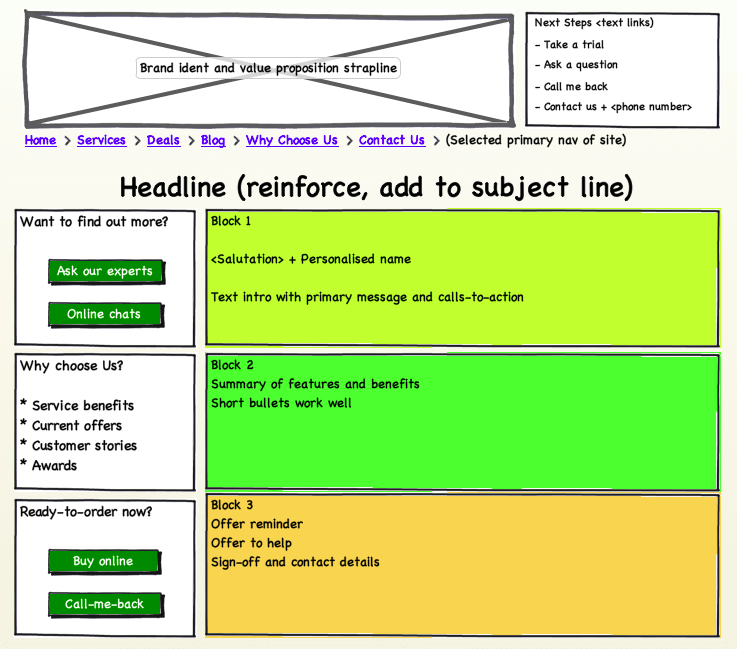
This more detailed example shows how a personalised communication can be specified within different blocks of a template - it’s part of our template for planning welcome sequences.

Email creative wireframe example from campaign

This is the creative that corresponds to the contact strategy defined above. It is simplified into clear blocks that can be tailored for different waves in the campaign. The left sidebar which has a high visual emphasis, so is good for response is fixed and covers both branding and response goals.

We like the simplicity of Balsamiq for mocking up these types of layouts.

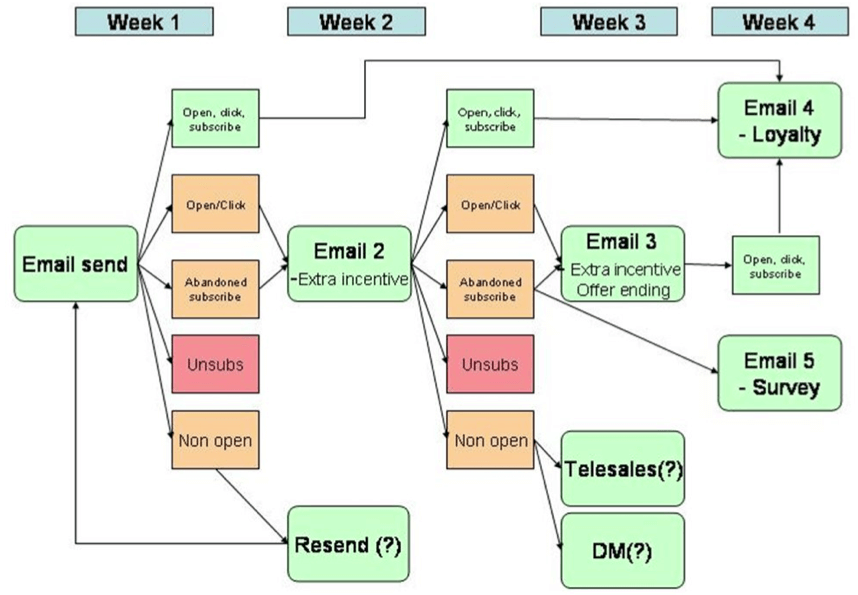
Example 3.  Using a flow-chart to summarise campaign waves

This example gives a more visual representation of a multi-wave campaign through time showing the “Sense and respond" or "digital body language" approach where follow up triggered communications depend on whether the email has been open or which links have been clicked upon.

A super-intelligent approach assesses the value of the customer and their propensity to convert and then follows up with the most appropriate medium to gain conversion. So a high-value customer may receive a phone call or direct mail which could maximise conversion.


from Blog – Smart Insights http://www.smartinsights.com/email-marketing/behavioural-email-marketing/how-to-plan-event-triggered-email-campaigns/

via Tumblr http://euro3plast-fr.tumblr.com/post/161234293444