Friday, 2 December 2016

Data Science & Digital Marketing: A Match Made In Heaven

The post Data Science & Digital Marketing: A Match Made In Heaven appeared first on Digital Marketing Blog by Adobe.


from Digital Marketing Blog by Adobe https://blogs.adobe.com/digitalmarketing/analytics/data-science-digital-marketing-match-made-heaven/

via Tumblr http://euro3plast-fr.tumblr.com/post/153941479134

How Social Networks, Influencers, and Other Marketing Channels Impact the Holiday Shopping Season

Thanksgiving has come and gone. The turkey has been eaten, and the stuffing has grown cold, so we now turn our attention to Christmas. With the holiday shopping season upon us, where do you turn for gift-giving ideas? Someone in your family? A magazine? The giant newspaper, full of ads, you receive on Thanksgiving Day? According to statistics compiled by Tap Influence (Ogilvy Cannes, 2014), nearly 8 out of 10 consumers will turn to social networks for holiday-shopping guidance, and 1 in 2 say they will harness recommendations from influencers to help them make their purchase decisions.

A large portion of consumers turn to social networks and influencers to help them decide what gifts will make the cut on their holiday shopping lists. Here’s how businesses can harness these and other marketing channels to achieve success this holiday season.

1. External Influencers
This group has a highly engaged audience and provides great access to consumers in various sectors.

Retail Fashion
A strong group of fashion influencers is popping up, but Chiara Ferragni (@chiaraFerragni), Aimee Song (@songofstyle), and Wendy Nguyen (@wendynguyen) are three to keep an eye on. They were all named top fashion influencers by Fashionista and have more than five million engaged fans across Twitter, Instagram, and YouTube. This group, along with others, is the new way to catalog. Forget direct mail — if you want the new generation of consumers to buy your product, then you need to connect with these influencers.

Business 2 Business (B2B)
Even B2B companies jump in on the holiday shopping madness by releasing content about shopping or marketing as a way to engage potential customers. It’s also a great time to publish content on 2017 industry outlooks. Brian Fanzo (@isocialfanz), Daniel Newman (@danielnewmanUV), and Gary Vee (@garyvee) all publish consistently great work on social networks and on their blogs regarding the future of work and technology. Gary recently wrote a great piece discussing why influencer matters more than numbers.

2. Internal Influencers
According to a survey from Experticity, 94 percent of retail associates inform their families and friends about deals at their stores. Almost one-half say that they have up to 10 conversations each week about these products. Walmart alone employs 1.5 million people in its 5,000 US stores. Marsha Collier said, in a recent blog post, “Your employees are the face of your company. They can also be valuable promoters for your message, why not try a new way of return on human investment? Need additional WOM? Your employees are first in line to help, just ask them.”

3. Social Media
Along with regular promotions on social channels, social listening can help predict what products will be hot sellers this season. You could also look to follow the REI model — #Optoutside has been hugely successful in promoting the REI brand from both an external and internal perspective.

4. Email
According to Adobe Digital Insights, email accounted for nearly 20 percent of sales on Black Friday. It may be contained to just a single day or time period, but email continues to be a steady drumbeat of content to keep your company/product top-of-mind for consumers.

Bottom Line
We are continuing to move along a generational shift in marketing in which people don’t want to be marketed to, but rather influenced by others who they trust — whether that is your social-media friends or an influencer, harnessing the changes in social and marketing will help to make the season bright.

The post How Social Networks, Influencers, and Other Marketing Channels Impact the Holiday Shopping Season appeared first on Digital Marketing Blog by Adobe.


from Digital Marketing Blog by Adobe https://blogs.adobe.com/digitalmarketing/analytics/social-networks-influencers-marketing-channels-impact-holiday-shopping-season/

via Tumblr http://euro3plast-fr.tumblr.com/post/153941479079

Digital Marketing in the airline / aviation sector

How digital innovation is engaging audiences and improving customer experience in the airline / aviation sector

This is the first in a new series looking at digital innovation and transformation in different B2B sectors aimed to inspire business-to-business marketers, this post from regular B2B marketing commentator RenĂ© Power looks at how digital technologies are being deployed within the blossoming air travel and aviation sector to enhance customer experiences at every stage of the process.

As you read, think about what ideas you might take forward into your own sector?

Air travel is a growing sector

There continues to be an explosion in air travel, which makes it a very lucrative industry to be in. Air travel numbers themselves are mind-boggling. Published forecasts predict the total number of people flying on U.S. airlines will increase by 0.8 percent from 2013 levels to 745.5 million in 2014 and grow to 1.15 billion in 2034.

But it’s not just the U.S. The International Air Transport Association (IATA) released its first 20-year passenger growth forecast, projecting passenger numbers to rise to 7.3 billion by 2034 - a 4.1% average annual growth in demand for air connectivity that will result in more than a doubling of the 3.3 billion passengers that travelled in 2014.

And China will overtake the U.S as the world’s largest passenger market. By 2034 flights to, from and within China will account for some 1.3 billion passengers, 856 million more than 2014 with an average annual growth rate of 5.5%.

What does the passenger experience look like?

This infographic illustrates how technology sits at the heart of the sector and enables the incredible growth in Digital Marketing in the Airline industry we’re seeing.

Passenger Experience 2015
The customer pathway in air travel can be segmented into the following areas:

  • Pre-travel - online reservation and online check-in
  • Check-in, validation, baggage & security
  • Airport services and ‘passenger way-finding’
  • Lounges, gates and boarding
  • In the air
  • Immigration and arrivals

Let’s look at some of the more prevalent areas in chronological order.

Online reservation

Every airline, and airport, has a responsive, ecommerce platform (and increasingly an app) that integrates the latest UX thinking to get customers quickly to the point of search, select and purchase.

The data and permissions at this point are critical to employing technology further along the process.

Often, there is also the opportunity to bundle, and as we’ve seen with some providers, giving a mobile number at the point of booking and reconfirming at check-in can allow for targeted offers and information alerts throughout the journey that follows using some of the technologies that follow.

BA website

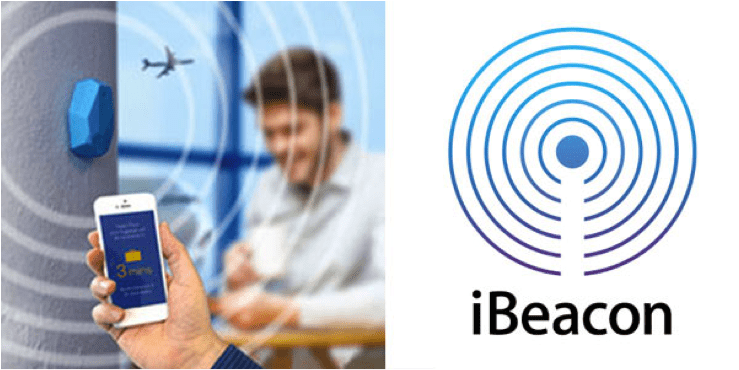
Wayfinding - iBeacons

When a new technology arrives on the scene, it often takes a number of years to gain the traction it needs to realise its full potential. Take Near Field Communication (NFC) as an example. This technology has been touted as the “next big thing” for a number of years without yet gaining the widespread uptake it initially seemed destined to achieve.

However, iBeacons have come to the fore, and unlike NFC, the technology has quickly emerged as a popular tool among travel industry stakeholders. The key to its rise seems to be the fact that a variety of uses have already been highlighted. American Airlines is using iBeacons to improve wayfinding at Dallas/Fort Worth Airport.

ibeacons

EasyJet is using them to send location-specific messages to passengers’ smartphones, Japan Airlines is tracking members of staff in the gate area, and Virgin Atlantic is using iBeacons to improve the airport experience for its premium passengers.

With so many use cases already apparent, and even more likely to emerge in the coming months, iBeacons appear to be far more than just a short-term fad.

Airport services - digital display

The rise of airport and airline apps, and the widespread preference among passengers to search for and consume information via their mobile devices, had some people questioning whether digital displays in airports would soon become a thing of the past.

Instead, quite the opposite is happening, as airports and suppliers have identified that smartphones and digital displays can actually complement one another.

Quantas Qview

A great example is Qantas, which has launched Qview, a digital experience for premium passengers that is enabled by synchronising electronic devices with the digital displays in lounges. If a passenger is reading a news story on their tablet, for example, it can also be displayed on the digital screen in the lounge, alongside real-time gate and boarding information, meaning all the information they need can be found in one place.

Quantas Qview2

Also in Australia, there are trials involving Google, in which passengers could use NFC or QR codes to interact with dozens of digital billboards to access the Google Play store and download content via the airport Wi-Fi.

LAX is offering a digital, multi-sensory experience in the Bradley West Terminal, which allows passengers to interact with the infrastructure using smart phones and tablets.

The digital traveller is clearly the future, so expect to see airports finding innovative ways to allow them to interact with their surroundings going forward.

Predictive modeling for traffic flow

Tracking passengers throughout the airport has a number of benefits, ranging from knowing how many people are in a specific retail area, to proactively managing bottlenecks as queues start to build up at certain checkpoints.

At Copenhagen Airport, for instance, sensor-based predictive modeling is used to measure the passenger flow and waiting times, allowing the airport to allocate staff and optimise every inch of the terminal based on the number of people in one area at any given time.

Predictive modelling

Elsewhere, Finavia has also announced that it will be the first airport to track passengers via their smartphones throughout the entire airport journey, from the car park to the departure gate, both to manage queues and to create new commercial opportunities through the ability to interact with passengers based on their location.

These digital innovations may not be seen directly by passengers, but they can certainly help to contribute to a less stressful, more personalised experience for them in the terminal.

Retail - apps integrating NFC

Tapping into today’s ‘coffee culture’ Air New Zealand has been featuring barista’s who make freshly brewed coffee to passenger’s preferences in its ‘Koru’ lounges for some time.

Lounge guests can order their favourite coffee by ticking a few boxes on a piece of paper, add their name and hand it over.

Retail apps

In a clever move, flyers now can order Barista-made coffee via ANZ’s tablet or smartphone app the minute they walk into one of the airline’s Koru Clubs around New Zealand, including its international lounge at Auckland Airport.

Boarding - wearables

A list of the new technologies that will play an important role in defining the airport experience of the future wouldn’t be complete without a mention of wearable technology. Virgin Atlantic led the way with the first trial of its kind in London Heathrow’s Upper Class Wing, and has since announced that it will productionize Google Glass.

Glass for boarding

The likes of Vueling, Iberia and AirBerlin already offer smartwatch boarding passes, Copenhagen Airport has undertaken a passenger-facing trial of Google Glass, and Japan Airlines has equipped select members of staff with smartwatches as part of an ongoing trial.

Watch check in

With Google Glass set to drop in price as its various uses in the enterprise space continue to be highlighted, and with other players such as Vuzix and Droiders making significant advancements in this space, it won’t be long before these wearable technology trials become permanent implementations.

Summary

The customer pathway in air travel starts on a screen on a phone or computer and ends returning home with their luggage intact, incredible memories and new contacts.

These digital innovations bring positive impacts on everyone in the industry - the airlines, the airports, the infrastructure companies, third parties feeding off the growth in travel and, of course, customers.

Have you plotted out how and where digital technologies could be brought to bear on your own customer interactions? What could you implement that would give you a real competitive advantage?


from Blog – Smart Insights http://www.smartinsights.com/b2b-digital-marketing/b2b-strategy/digital-marketing-in-the-airline-industry/

via Tumblr http://euro3plast-fr.tumblr.com/post/153940896724

Thursday, 1 December 2016

2016 Black Friday Shopping Cart Abandonment Rates

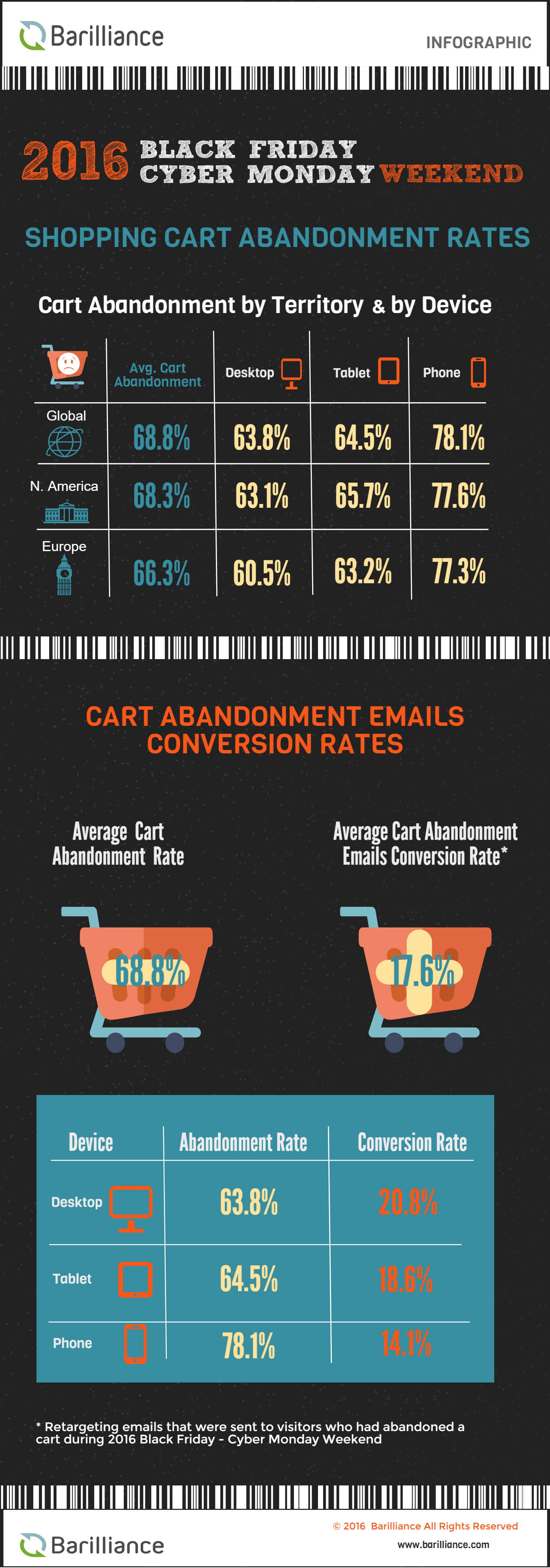
Chart of the Day:  Black Friday and Cyber Monday Cart Abandonment Rates Jump to 68%

Cart Abandonment is the scourge of ecommerce retailers everywhere, and this year it seems to be on the increase. New data emerging from the two busiest ecommerce days of 2016 (Black Friday and Cyber Monday) shows extremely high cart abandonment rates across the board. These are particularly high on mobile devices, where 78% of carts are abandoned.

Ecommerce retailers should be asking themselves, are 4 out of 5 people abandoning their carts because they’re having second thoughts about purchasing, or is it because the checkout pages aren’t properly optimized for mobile? If a customer has to use fiddly forms that are hard to complete on a Smartphone they are far more likely to abandon their cart.

It’s not all bad news though. Although the cart abandonment rates are huge, many of these customers can be nudged into purchasing through well-crafted cart abandonment emails reminding or encouraging them to complete their purchase. On Black Friday and Cyber Monday this year these emails had an average conversion rate of 17.6%, which is pretty tasty. If you aren’t running a cart abandonment email campaign you could be missing out on a huge potential stream of revenue. If 68% of customers abandon their carts and 17.6% of them can be converted by email, then cart abandonment emails could be contributing 10-11% of all sales.

shopping-cart-abandonment-rates-on-2016-black-friday-cyber-monday-weekend

Thanks to Brilliance for publishing this Chart.


from Blog – Smart Insights http://www.smartinsights.com/email-marketing/email-targeting/2016-black-friday-shopping-cart-abandonment-rates/

via Tumblr http://euro3plast-fr.tumblr.com/post/153908835129

Omnichannel travel retail strategy – A case study of a new digital in-store technology concept

Lesson’s from TUI’s digitally integrated concept store

Omnichannel is now the de-facto retail strategy for major travel brands or is at least often the desired goal. TUI explored the concept of going ‘beyond Omni-channel’. ‘Beyond-Omni-channel’ to me sounded a lot like ‘Post-digital’, a term that is often misleading. Post-digital is about digital being pervasive and everything being digital, rather than having moved beyond digital. It makes good points regarding the breaking down of silos between departments, but the term ‘post-digital’ doesn’t convey this clearly.

How an Omnichannel travel-booking approaches reinforces the strength of individual channels

An interesting point regarding the effectiveness of TUI’s travel agency service made was that the distribution channels were in no way mutually exclusive, and in fact were self-reinforcing. A survey conducted by TUI discovered that 30% of their customers started their customer journey through a different medium to the way they eventually paid for the holiday.

One third of their sales are still taking part in their physical stores, and they find that often these people had already used the site extensively for research. Many came first to physical branches and then bought online, whilst others researched online at first and then came into a branch to purchase and finalise details.

Doug explained that the customer has become multi-channel focused and the customer journey more complex. Because of this, every interaction with the brand, whether online or in physical branches needs to be optimised to avoid pushing customers to competitors rather than returning to other channels to complete the purchase.

The survey previously mentioned by TUI also found that having physical branches increased customer trust in the brand, even among those who were only researching and purchasing their holidays via the website. Having physical branches gives somewhere concrete to rely on and means there is always the opportunity to meet a representative of the company face to face should any problems emerge. An interesting point to bear in mind for retail businesses considering a shift to digital and ecommerce.

In-store travel technology

The way TUI went about optimising its Omnichannel strategy involved the integration of digital within physical stores, which reflected what customers were already doing. They focused on making sure the technology put into their stores was delightful, usable and useful. It had to excite in order to generate interest in the products on offer, it had to be useable even by the more technophobic elements of their customer base and it had to provide a solution to customer’s problems.

TUI used large screens on their storefronts to display excellent content to excite customers. It never showed offers or prices or details, but simply tried to convey how incredible the holiday experiences on offer were.

Retail-travel

On entering the store, there are interactive maps on the walls which customers can touch to research specific destinations, as well as show friends and family where they have been. The map screen was made large enough so that other customers could see what other customers were looking at to help inspire them to consider holiday destinations they possibly would not have considered otherwise.

When clicking on certain areas on the map more information can be gathered on specific hotels and destinations, where video content and reviews are displayed.

Table-size touch screens are also dotted around the store to allow customers to research their holidays via powerful search functions where they can use a series of filters and search criteria to narrow in on their dream holidays.

Omnichannel travel technology

The touch screens can also email content back to users from any screen to remind them what they discovered once they return home to review with their partners than families.

An additional feature is users can research their holidays by ‘mood’, where they are shown various photos of different holiday activates and they select as many as they want and are then given suggestions about what holidays they may enjoy.

When customers have booked their holidays within the store they are encouraged to take selfies which are then shared with their social communities, generating excitement for the customer and possibly attracting additional business for no advertising expenditure.

Technology is essential for good integration between digital and physical channels, and by integrating these channels well they can deliver better increases than by optimising either independently.

The results

The results of the technology integration into physical stores were excellent. It delivered ROI via a massive sales increase (sales tripled in their Bluewater flagship store where the changes were pioneered) and average spend also increased in the stores that transformed via the aforementioned technology. TUI was also able to reduce discounts and got excellent feedback regarding the changes from customers, and won several awards.

These changes which were made initially in TUIs blue water store have now been rolled out to 30 shops across the country this has again delivered impressive results.


from Blog – Smart Insights http://www.smartinsights.com/ecommerce/multichannel-retail-strategy/omnichannel-travel-retail-strategy-a-case-study-of-a-new-digital-in-store-technology/

via Tumblr http://euro3plast-fr.tumblr.com/post/153906402954

Subscriber to Customer: Winning the Conversion Journey with Marketing Automation

Marketing Automation offers the key to effectively nurturing leads through the customer’s journey

According to a research published by Smart Insights in 2016, 47% of businesses don’t have a digital marketing strategy. The findings show that businesses have a big challenge structuring their digital marketing strategy and knowing where to start.

So, how about we start by laying down some of the groundwork that you need to lay down in order to create and implement your world-class digital marketing strategy the right way from scratch.

The strategy includes 4 key stages of the RACE framework - plus the initial Plan stage. Just in case you’re not familiar with RACE, the stages are as follows:

1.    Plan:

This stage involves creating the overall strategy with SMART goals and measurable KPIs to run your digital marketing strategy.

2.    Reach:

Most customer’s journey’s begin through doing personal research instead of simply talking to a sales person. This means that providing content to feed this research is invaluable. Therefore, developing appropriate content throughout the sales process should build awareness and draw people into your sales funnel.

3.    InterACT:

Since not everyone you attract becomes a customer immediately, you don’t want to waste your efforts by letting any prospects slip through your fingers. This means that you have to use strategies to re-target and lead prospects back into the sales funnel. This is the focus of this stage.

4.    Convert:

Once you have attracted good leads you ultimately want them to make a purchase or opt-in to one of your offers. This is the stage where you turn subscribers into customers. And yes, a good marketing automation tool as well as remarketing strategies to ensure contextual relevance (addressing each lead/subscriber’s needs according to their stage in the sales funnel), can help you a lot at this stage.

5.    Engage:

After converting subscribers into customers, you still need to nurture them. The idea here is for your customers to become repeat customers and not just one-time customers.

Nurturing requires personal attention through long-term engagement in order to build customer loyalty. This is done through listening and talking to your customers wherever they may be or wherever they like to hang-out online.

What makes winning the conversion journey with marketing automation difficult?

According to a survey by Ascend2 and Research Partners done on February 2016, there are several barriers that make marketing automation unsuccessful. The most significant barriers are as follows;

top-marketing-autmation-trends-2017

How to win with marketing automation

In order to be successful and win with conversion journey marketing automation, setting SMART goals for your marketing automation system and for your overall sales funnel will be necessary for you to follow through on. The following goals should be your priority:

  1. Growing lead generation
  2. Enhance lead nurturing
  3. Grow sales revenue
  4. Enhance customer engagement
  5. Enhance marketing productivity
  6. Enhance performance measurability
  7. Enhance campaign targeting

With these goals in mind, the following activities need to be a part of your marketing automation strategy, especially from the subscriber to customer phase.

1. Triggered actions

Paying attention to subscribers and having real-time responses to the changing status of leads in the sales funnel can make the difference between losing a customer and winning them over. Through marketing automation alerts, you can stay on top of targeted responses.

This will mean that careful profiling of prospects before they become subscribers will help you to better keep track of their stage in the sales funnel. As such, using lead forms to build profiles and tracking website behavior will help you figure out intentions, and the leads current buying status to better segment and nurture them.

2.    Analysis and reports

Analyzing the effectiveness of campaigns allows a better understanding of what’s most important in moving individuals through the sales funnel. This is very useful since it will allow you to move leads through the sales funnel much faster due to automated nurturing.

metrics-to-measure

Important metrics and points of analysis to pay attention in marketing automation

3.    Lead nurturing

According to The Annuitas Group, nurtured leads makes 47% larger purchases than non-nurtured leads. If you want to nurture your leads most effectively, personalized one-on-one attention is a must. If you don’t engage in personalized nurturing, your competitors will and you will lose customers.

Personalized attention is about having interactive experiences, building relationships, trust and recognition for your brand. Providing this positive experience will allow you to win the nurturing game and contribute to a successful conversion journey for your leads.

Additionally, by providing contextual relevance, that is, through providing dynamic content in order maintain interest and engagement, you will create a better user experience.

4.    Email marketing

Using marketing automation to appropriately educate and remind subscribers that you are the best solution when they are ready to make the buying decision. Marketing automation can help you to stay top of mind.

5.    Integration capabilities

Since sales and marketing teams have been using other technologies like CRMs long before marketing automation tools, integrating these tools with marketing automation tools is crucial.

For example, sending the CRM all the intelligence and data that you gather trough the marketing automation tool will provide for better interaction and conversations with leads. This is because the sales teams will have all the necessary information in the same pipeline that they are already comfortable using.

6.    Lead scoring

Since sales teams have to do so much more within a shorter time period, time is more precious than ever before. This means that leads have to be prioritized in order to increase efficiency and effectiveness. As such, setting up lead scoring systems through marketing automation systems will bring the urgency and prioritization to the forefront of the sales teams tasks.

7.    List segmentation

Email lists are important for determining who receives emails through the marketing automation system. What’s more important however is after initial lists have been created, rules need to be set up so that the list can be refined and leads moved to relevant in-between lists in the sales funnel.

The refined lists will allow leads to receive appropriate content with respect to their stage in the sales funnel. This is mostly done through behavioral segmentation.

Conclusion

Converting leads and engaging customers is definitely not easy work. Customers expect personalized attention and this requires significantly more meticulousness throughout the varied channels where leads and customers interact.

Fortunately, this is where the promise of good marketing automation systems come in. In essence, marketing automation allows for personalized attention through the different ways that businesses engage with their prospects, leads and customers. This thorough, personalized, unified and seamless sales experience is what will allow you to win the conversion journey.


from Blog – Smart Insights http://www.smartinsights.com/lead-generation/marketing-automation/subscriber-customer-winning-conversion-journey-marketing-automation/

via Tumblr http://euro3plast-fr.tumblr.com/post/153900992804

4 proven ways to generate website leads at events

Examples of companies successfully using events to generate high-quality leads

Whether you’re organising events or attending them, face-to-face marketing can be one of the most powerful lead gen tools in your arsenal. Pair this up with a killer data capture campaign and you’ve got a recipe for success. We asked four companies to share their lead generation tips so you can follow their success.

Content

According to Demand Metric, content marketing generates three times as many leads as traditional outbound marketing – but costs 62% less. An industry report, for example, is a particularly cost-effective way to capture leads and get eyes on your brand.

events

Salesforce recruitment specialists Mason Frank International did just that at Dreamforce 2016, when the company unveiled its latest salary survey.

“From a lead-gen standpoint we wanted to engage job candidates by supplying genuinely useful information on how much they should be earning as a Salesforce professional,” explains Nicola Lloyd, the company’s Senior Event Marketing Executive.

“Potential clients – for example, a company looking to hire a Salesforce developer – also benefited from our insights into employee motivation, current software trends, and Salesforce migration.”

The success of the report hinges on data capture. In order to download the survey, interested parties were asked to supply their name, email address, telephone number and employment status – or collect a printed version at the company’s Dreamforce booth.

“Our salary survey and supporting presentation helped drive footfall to our stand, which again allowed us to identify interested parties and find out how we could help them,” says Nicola.

Social media

Jay Baer, President of Convince & Convert, believes social media is the key to creating a buzz around events.

“It used to be you spent five minutes registering for an event, and then showed up on the big day, went to a few workshops, drank two free Coronas, and went home,” he explains.

“Social media changes all of that, enabling events and their planners to have long-term, nuanced, shifting interactions with attendees.”

Baer’s advice can be distilled down to this:

  1. Use social media (and event websites) to shout about your attendance – then encourage your followers to get involved too. Polls and competitions are great ways to drive engagement.
  2. Create teaser videos from your speakers and partners and build out blog content around the venue, event or city you’re visiting.
  3. Map out a hashtag around your event (the shorter the better) and track its success using a tool like TweetWally.
  4. Create your own media and push it out through social. This could be a daily podcast or a Facebook Live stream from the event.

Mobile workshops

Pedro Carvalho works at Vidsy, a leading platform for brands to create mobile-first video for social at scale. Interactive events play a huge role in their lead generation strategy.

“We’re on social video, which is a very new way for brands to connect with their audiences,” explains Petro.

“As a result, there’s a lot of education to be done. Clients want to be educated and we deeply believe that the more educated they are, the bigger the probability of them wanting to work with us.

“We’ve developed something called the Vidsy Mobile Workshop, which is a two hour event where we explain everything on mobile video and do some fun exercises with our prospects.”

Pedro says that demand has been great so far. In the last 10 months alone the company has worked with the likes of Unilever, L'Oreal, Vodafone and Barclays.

The Daily Mail, Marks and Spencer and Barclays have also signed up for the company’s online workshops.

“Our workshops are very practical. We usually kick-off by explaining to companies how online video works and what they can do to increase their chances of a successful campaign.

“Once everyone has the basics, we make teams and give them assignments. These assignments are usually tailored to the business we’re visiting and include:

  • Defining their audience on the web
  • Adapt a whole previous TV campaign for mobile / social only
  • Write a briefing for a fictional product

“Usually, we end with a contest where each team has to explain to the group their ideas. We always choose a winner. A bit of competition never hurts!”

So, what advice would Pedro give to other companies looking to run events as part of a data capture strategy? “Only do it if you can really provide value. Boring events can destroy your relationship with the client.

“Also, you don’t have to run your own events. There’s a lot of things happening in the event industry and you’d be surprised how easy it is to get a seat, become a speaker or sometimes just go and network with your prospects for free.”

Free stuff

Hayley Smith, founder of Boxed Out PR, organises events for her clients – including launch parties, trade shows, exhibitions and press events.

“Though each event has its own requirements and set up I use similar mechanisms in order capture data and generate leads,” explains Hayley.
“For B2C events, competitions and live offers are always beneficial to promote engagement and for converting traffic to social followers.”

Offering something free in exchange for a follow or a like is simple, but can also create recognition that will really help with your branded search.

“Tote bags are always useful or play to people’s interests. If you’re a fitness brand, offer branded water bottles or sportswear - and be clever with it.

“Ultimately you want to engage with your audience and use it as an opportunity to collect data so you can remarket to them.”


from Blog – Smart Insights http://www.smartinsights.com/lead-generation/event-marketing/4-proven-ways-generate-website-leads-events/

via Tumblr http://euro3plast-fr.tumblr.com/post/153898996899